
Xiaomi and MiniMax both unleash their ultimate moves, signaling the start of the Agent Pricing War.

 Prefer us on Google

On March 18 and 19, two Chinese companies successively released their respective Agent-oriented large models. The domestic AI startup MiniMax launched M2.7, and Xiaomi's large model team MiMo introduced V2-Pro. Both models entered the global top tier in the Agent benchmark, but their API output pricing is 1/21 and 1/8 of Claude Opus 4.6, respectively.
Both companies played their cards in the same week, but with completely different hands. They represent two completely different technical paths, betting on two futures of the Agent era.
Same Exam, 1/17 Tuition Fee
First, let's look at the most intuitive comparison.
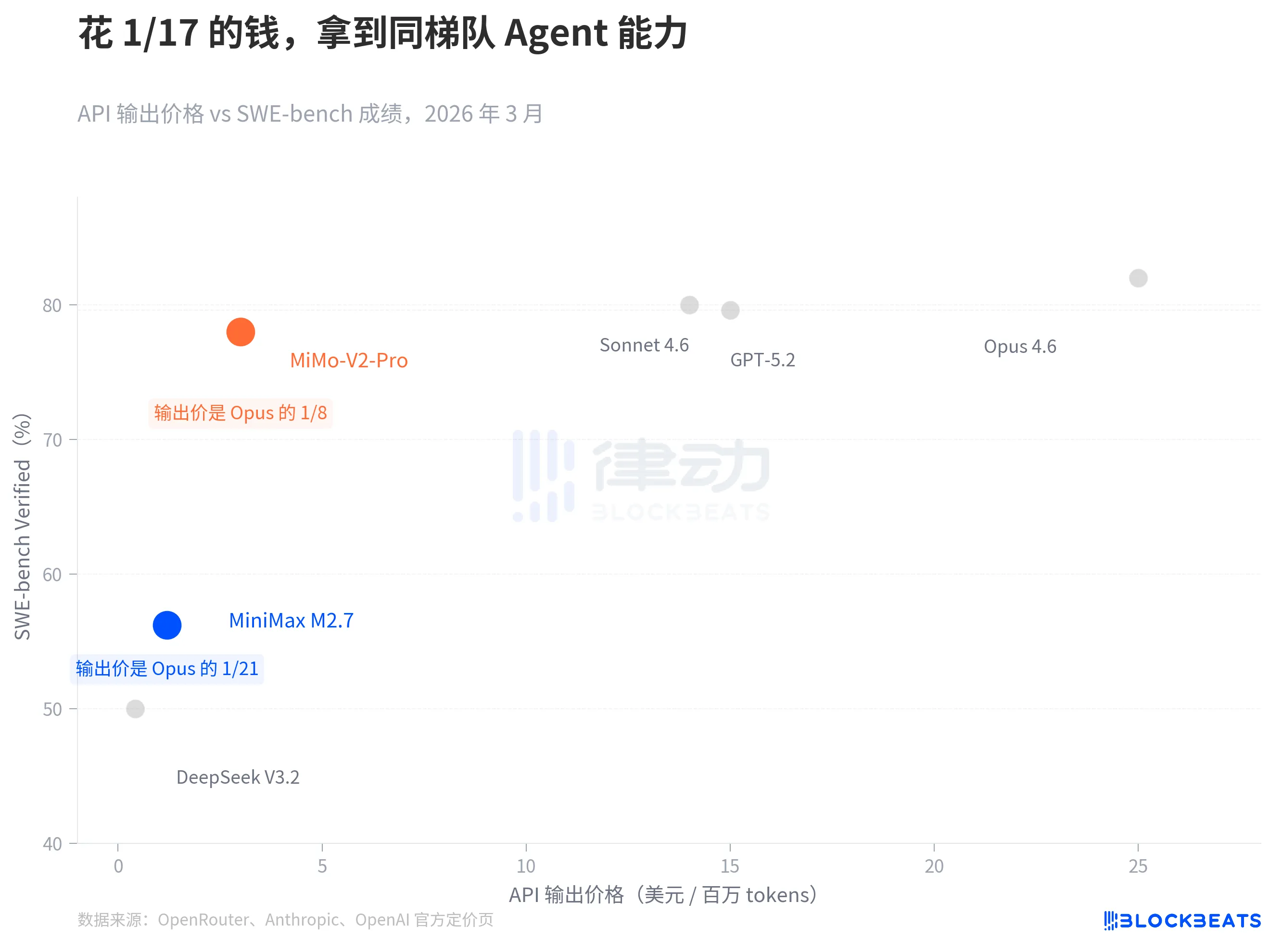
According to OpenRouter and various company official pricing pages, based on API output price (per million tokens), MiniMax M2.7 is $1.2, and MiMo-V2-Pro is $3. As a reference, the output price for Claude Opus 4.6 is $25, GPT-5.2 is $14, and Claude Sonnet 4.6 is $15.
The price difference is an order of magnitude, but the performance difference is not. In SWE-bench Verified (the current mainstream benchmark for measuring code engineering capability), MiMo-V2-Pro scored 78%, Sonnet 4.6 was 79.6%, a difference of less than two percentage points. M2.7's SWE-Pro score is 56.22%, on par with GPT-5.3-Codex. In VIBE-Pro (end-to-end project delivery capability), M2.7 scored 55.6%, approaching the level of Opus 4.6.
The focus of this chart is not on who is higher or lower—the benchmark systems of various companies are not entirely aligned, so direct comparisons should be cautious. The focus is on the "price-performance scissor difference": domestic Agent models have squeezed into the same performance band, but are in completely different price ranges.
Trillion Parameters vs. Self-evolution
Price is just the surface. The two companies have presented two completely different sets of trump cards.
MiMo-V2-Pro follows the "go big or go home" route. According to Xiaomi's official announcement, V2-Pro has over 1 trillion total parameters, 42B activation parameters, and supports an ultra-long context of 1 million tokens. Its core innovation is the Hybrid Attention mixed attention mechanism, adjusting the ratio of Sliding Window Attention (SWA) to Global Attention (GA) to 7:1—its predecessor V2-Flash was 5:1. This architecture makes the model more stable in scenarios where long documents are processed and multiple tool parallel calls in the Agent scene. In PinchBench (Agent tool invocation capability assessment), MiMo-V2-Pro scored 84%.
M2.7 took a completely different path. According to MiniMax's official tech blog post on March 18, M2.7's parameter count was not disclosed, but it demonstrated a "self-iterative evolution" mechanism: the model autonomously ran over 100 optimization loops, including analyzing failure trajectories, planning modifications, modifying its own code architecture, running evaluations, and looping again, ultimately achieving a 30% performance improvement on an internal evaluation set. In the MLE Bench Lite (Machine Learning Contest Difficulty Assessment), out of 22 challenging problems, M2.7 secured 9 gold, 5 silver, and 1 bronze, with an average medal rate of 66.6%.
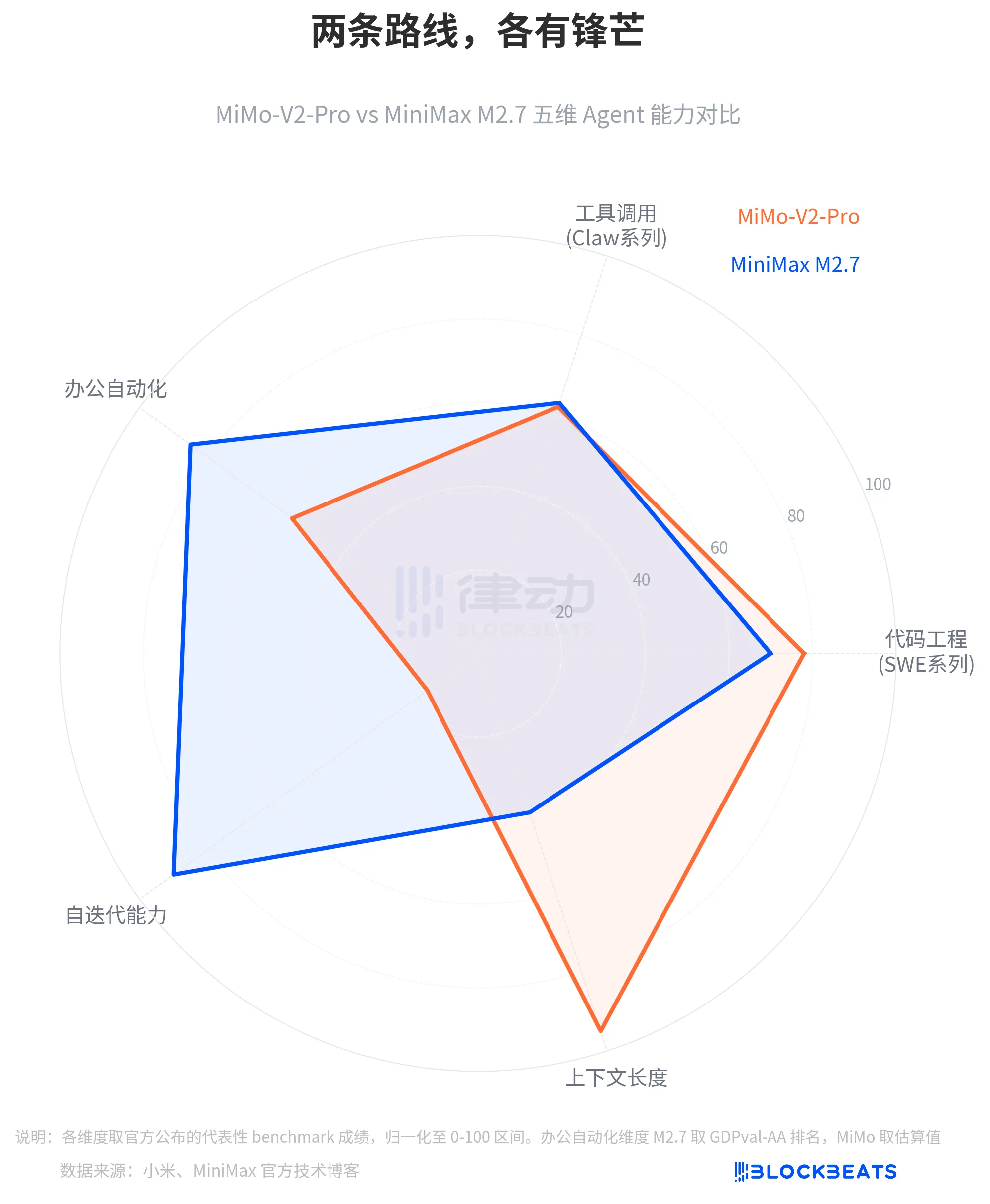
From five dimensions, the two paths are aimed in completely different directions: MiMo-V2-Pro clearly dominates in context length and code engineering dimensions, while M2.7 widens the gap in office automation and self-iterative capability. According to MiniMax's same tech blog post, M2.7 scored ELO 1495 on GDPval-AA (Office Document Processing Evaluation), ranking first among open-source models, and maintained a 97% skill compliance rate in the MM-Claw test covering over 40 complex skills.
Four Versions in Five Months
Not only are the technical paths of the two companies different, but their iteration rhythms are also completely different.
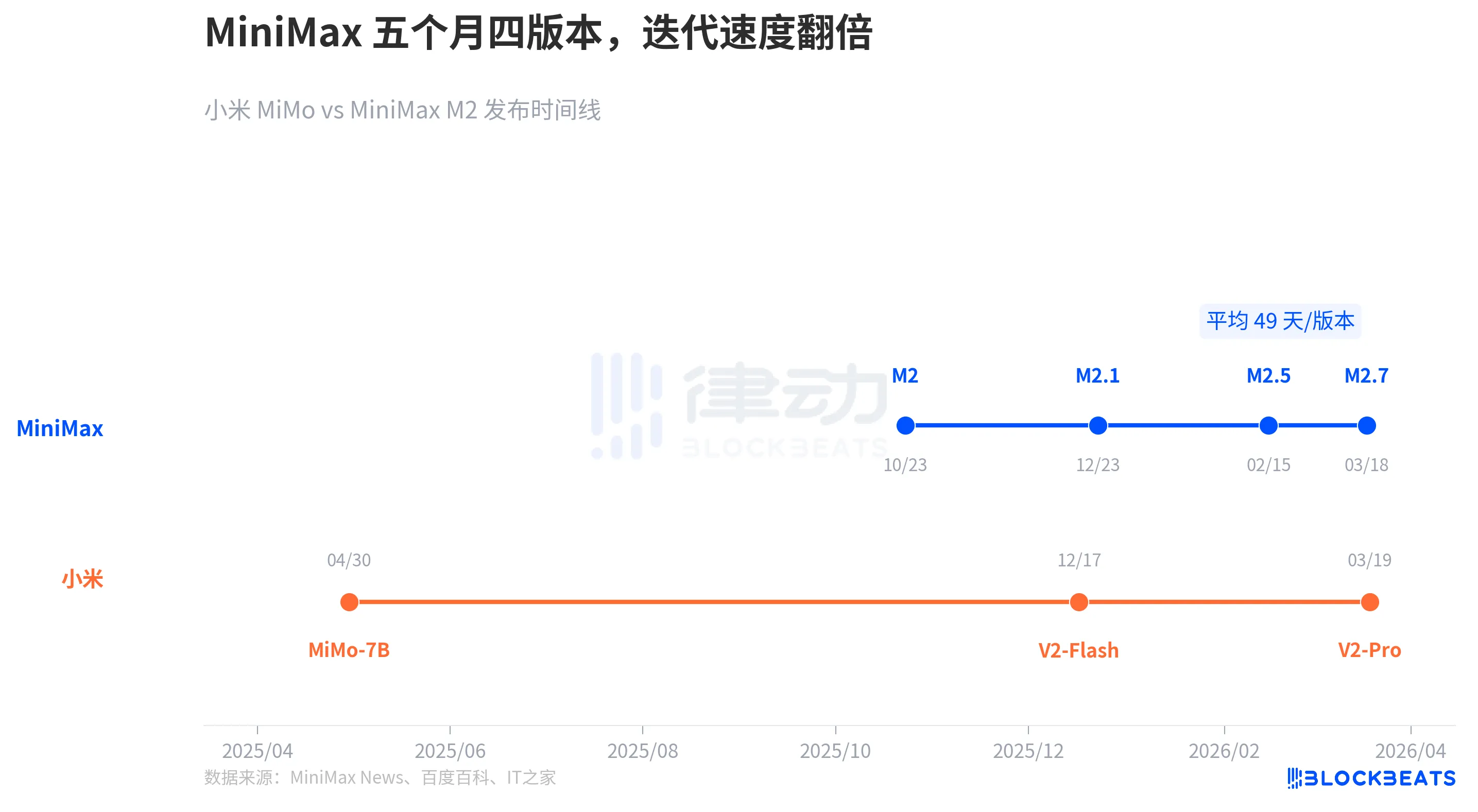
According to public release records, from the release of M2 in October 2025 to the release of M2.7 in March 2026, MiniMax iterated four versions within five months, averaging a major version every 49 days. The gap between M2.5 and M2.7 was only about 30 days.
The rhythm of Xiaomi's MiMo is different: MiMo-7B was released in April 2025 (an open-source inference model with 7B parameters), V2-Flash was released in December of the same year (with 309B total parameters), and V2-Pro was released in March 2026 (with 1T total parameters). The parameter scale between each generation is much larger, but the intervals between versions are also longer.
MiniMax chose small, frequent steps, with each iteration not making big leaps but at a very high frequency. M2.7's self-iterative mechanism itself is designed for "continuous evolution." Xiaomi opted for a more impactful approach, with each version featuring significant changes in parameter scale and architecture.
-- Price
Anonymous 8 Days, Summit OpenRouter
In addition to the technical roadmap, Xiaomi's release strategy has also broken industry conventions.
According to Reuters, on March 11, an anonymous model named Hunter Alpha appeared on the world's largest API aggregation platform, OpenRouter. No brand endorsement, no product launch event, no technical blog. Its API pricing was extremely low, yet its performance was surprisingly strong.
The community began to speculate about its origins. According to Republic World and several tech media reports, the most mainstream speculation was DeepSeek V4, as MiMo team leader Luo Fuli had previously worked on research at DeepSeek. The number of API calls quickly skyrocketed, with the total number of calls during the anonymous period exceeding 1 trillion tokens, reaching the top of the OpenRouter weekly rankings.
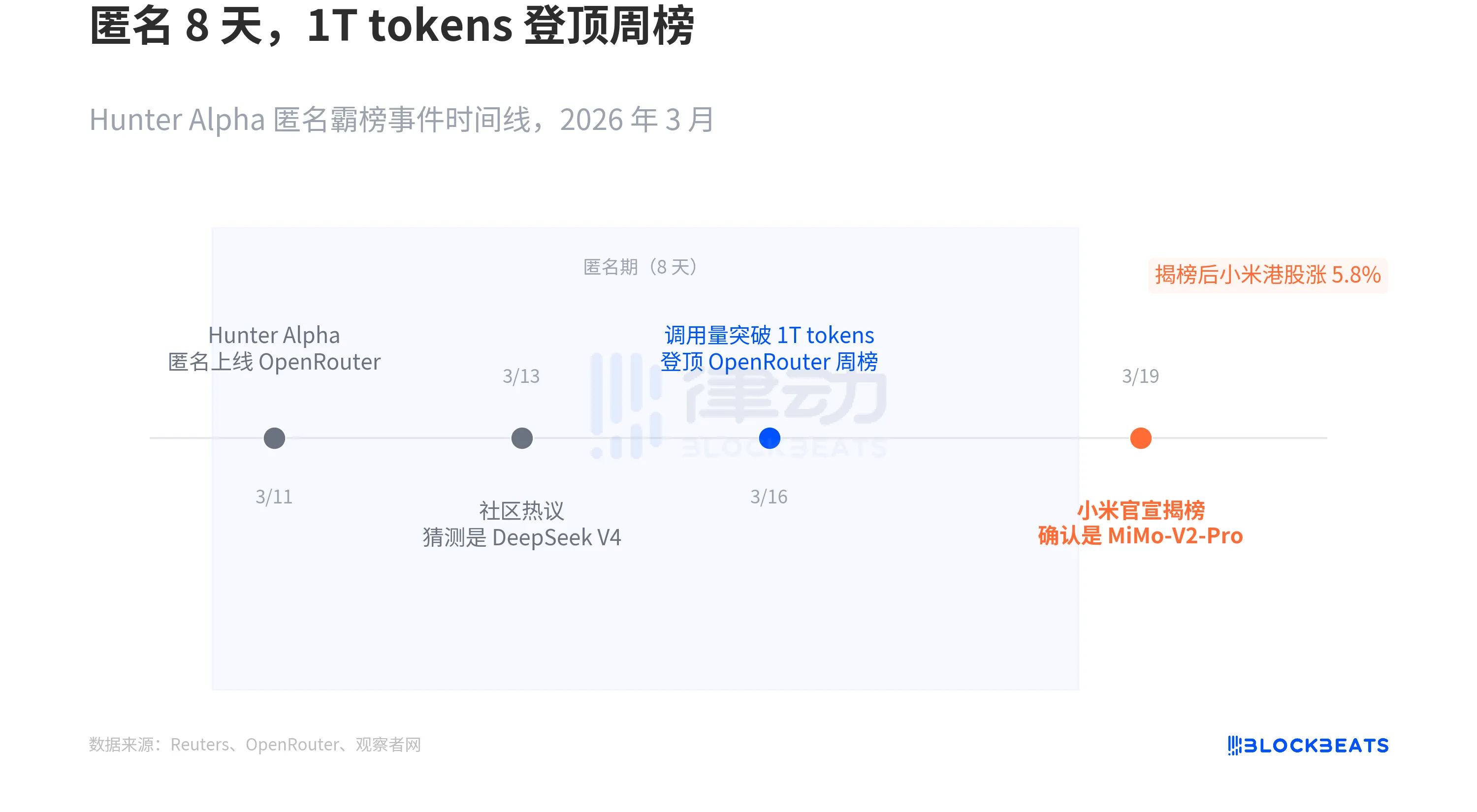
Early on March 19, Xiaomi revealed: Hunter Alpha is indeed MiMo-V2-Pro. According to the same Reuters report, Xiaomi's Hong Kong stock once surged by 5.8% after the revelation.
This is the first time a domestic large-scale model has proven itself on a global platform through purely blind testing. Not relying on the brand, not relying on publicity, it took 8 days to let developers vote with their feet.
This content is provided for general informational purposes only and doesn't constitute financial, investment, legal, or tax advice. Any events, rewards, online promotions, or related information mentioned herein should not be considered a recommendation, solicitation, or invitation to purchase, sell, trade, or otherwise deal in any crypto assets. Crypto assets are highly volatile and may result in loss. The availability of WEEX services, products, and related events may vary by region. You are responsible for ensuring that your participation is in accordance with applicable local laws and regulations.
You may also like
Solana Staking ETF Poised for Imminent Launch: Analysts Signal Green Light as of 2025-08-22
Exciting Times Ahead for Solana Enthusiasts Imagine the thrill of a rocket ready to blast off – that’s…

Bitcoin Spot Demand: The Signal That Hadn't Reappeared Since the October 2025 Record
Cofund Maps Over 24 Bitcoin Covenant Use Cases
Purchase of Cryptocurrency Through Intermediaries Will Be Available to Unqualified Investors
Saudi Arabia Leads Mecca Agreement, Oil Dollar System Faces New Trust Test

$1 Billion in 48 Hours: X Prepares Crypto Trading Function on Feed

The forex complex: How retail traders are adapting to volatile 2026 markets

Trump Beats the Fed: How Trading Boom Explodes in the UAE
LayerZero Unveils ATLAS Exchange Engine
Chile Requests the Extradition of Two Venezuelans Who Laundered Nearly USD 19 Million for the Tren de Aragua
Crypto investors should favor systematic strategies over Fed predictions, Moon Pursuit Capital says
MEXC stock futures trading volume in Asia surges over 3,300% in Q2

Operation Lighthouse: 14,000 Leads Delivered to Investigators Against Child Exploitation Networks
Binance founders used ‘The Simpsons’ codenames, former employees share

Crypto: Solana ETFs Record Their Biggest Day of the Year

Ray Dalio Warns of U.S. Debt Crisis and Recommends Gold and Bitcoin as Protection

Xbox and PlayStation Reassess Their Multiplatform Strategy, Emphasizing Exclusivity Again
The new Resident Evil movie will bring action to the first person
What is the cost of cheap borrowing?

Interview: Aptos CEO on AI Agents, Stablecoins, and Machine Commerce

Chainalysis identifies 7,700 suspect accounts in CSAM crypto operation

Ledger Wallet Vulnerability; Users Must Update Ethereum App to Version 1.22.2

AI: Hugging Face explores a sale that could value it at $13 billion
Why major crypto asset manager’s 25% buyback plan might recycle shares to employees instead of shrinking supply
Previously Bearish on Crypto Market, Jiang Zhuoer Quickly Turns Bullish: Ethereum is the Engine of the Bull Market
Trump Proposes a $1,700 Tax Credit to Boost School Choice in the U.S.

Linux 7.3 Expands Support for New RISC-V Extensions
Mozilla prepares default JPEG-XL support in Firefox 157
GNU Emacs 31.1 Enables Mouse Control by Default in Terminals
Grayscale Launches Zcash ETF Following Critical Privacy Flaw That Rocked the Cryptocurrency
Solana Staking ETF Poised for Imminent Launch: Analysts Signal Green Light as of 2025-08-22
Exciting Times Ahead for Solana Enthusiasts Imagine the thrill of a rocket ready to blast off – that’s…
Bitcoin Spot Demand: The Signal That Hadn't Reappeared Since the October 2025 Record
Cofund Maps Over 24 Bitcoin Covenant Use Cases
Purchase of Cryptocurrency Through Intermediaries Will Be Available to Unqualified Investors
Saudi Arabia Leads Mecca Agreement, Oil Dollar System Faces New Trust Test
$1 Billion in 48 Hours: X Prepares Crypto Trading Function on Feed

Contents
Latest articles


Latest coin listings on WEEX


