
The Chip Industry's Most Secure Middleman Just Took a Very Risky Turn

 Prefer us on Google

Between $40 billion and $150 billion is not a growth curve, but a self-disruption of a business model.
On March 24, Arm unveiled its first in-house data center CPU in the company's 35-year history in San Francisco. This chip, named AGI CPU, features 136 Neoverse V3 cores, TSMC 3nm process, 300W TDP, with Meta as the first customer for large-scale deployment within the year. Also announced as partners are OpenAI, Cerebras, Cloudflare, SAP, and SK Telecom.
Arm CEO Rene Haas provided a set of target numbers at the event, stating that the chip business is expected to achieve $15 billion in annual revenue by 2031, with total company revenue of $25 billion and earnings per share of $9.
What do these numbers mean? Arm's total company revenue for FY2025 (ending March 2025) was $40.07 billion, according to Arm's annual report data, with licensing revenue of $18.39 billion, royalty revenue of $21.68 billion, and a 97% gross margin. In other words, a company with $40 billion in annual revenue aims to achieve a scale close to Intel's entire data center division in just 5 years through a single new business. According to Intel's Q4 2024 financial report, Intel's DCAI (Data Center and AI) division had full-year revenue of $12.8 billion in 2024.
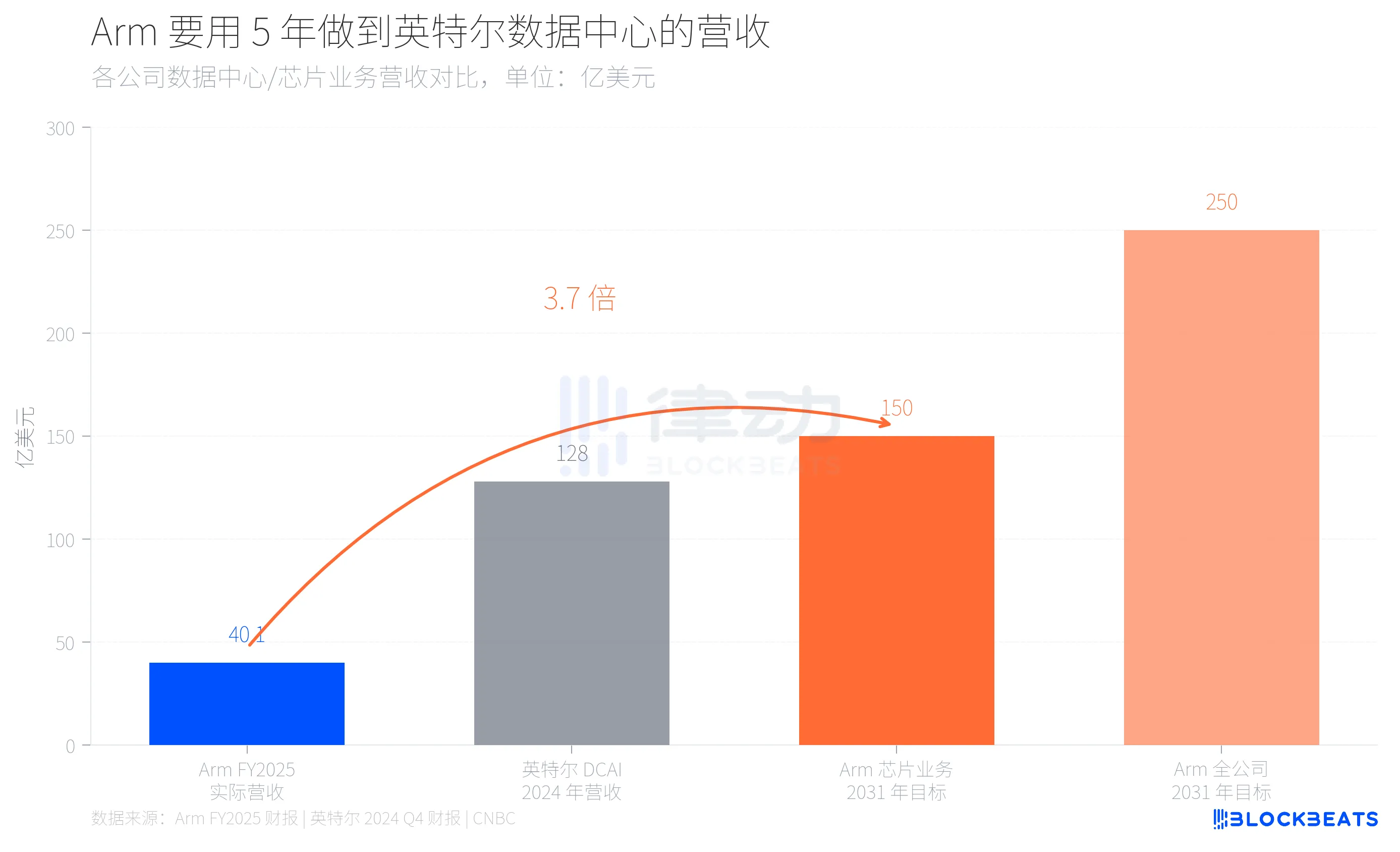
From $40 billion to $150 billion, behind the 3.7x leap is Arm's attempt to transform from a pure IP licensing company to a hybrid that sells both design blueprints and finished products. There is no precedent for this in the chip industry.
Why is Arm taking this risk? The answer lies in its customer list.
Over the past three years, Arm's largest data center customers have been doing the same thing. According to public data from AWS, Amazon has migrated over 50% of EC2 compute to its in-house Graviton chips, with the latest Graviton5 featuring 192 cores. As disclosed by Google Cloud, Google's Axion chip has already migrated over 30,000 internal applications, achieving an 80% energy efficiency gain. Microsoft's Cobalt 200 is also based on Arm Neoverse architecture, TSMC 3nm process, with 132 cores.
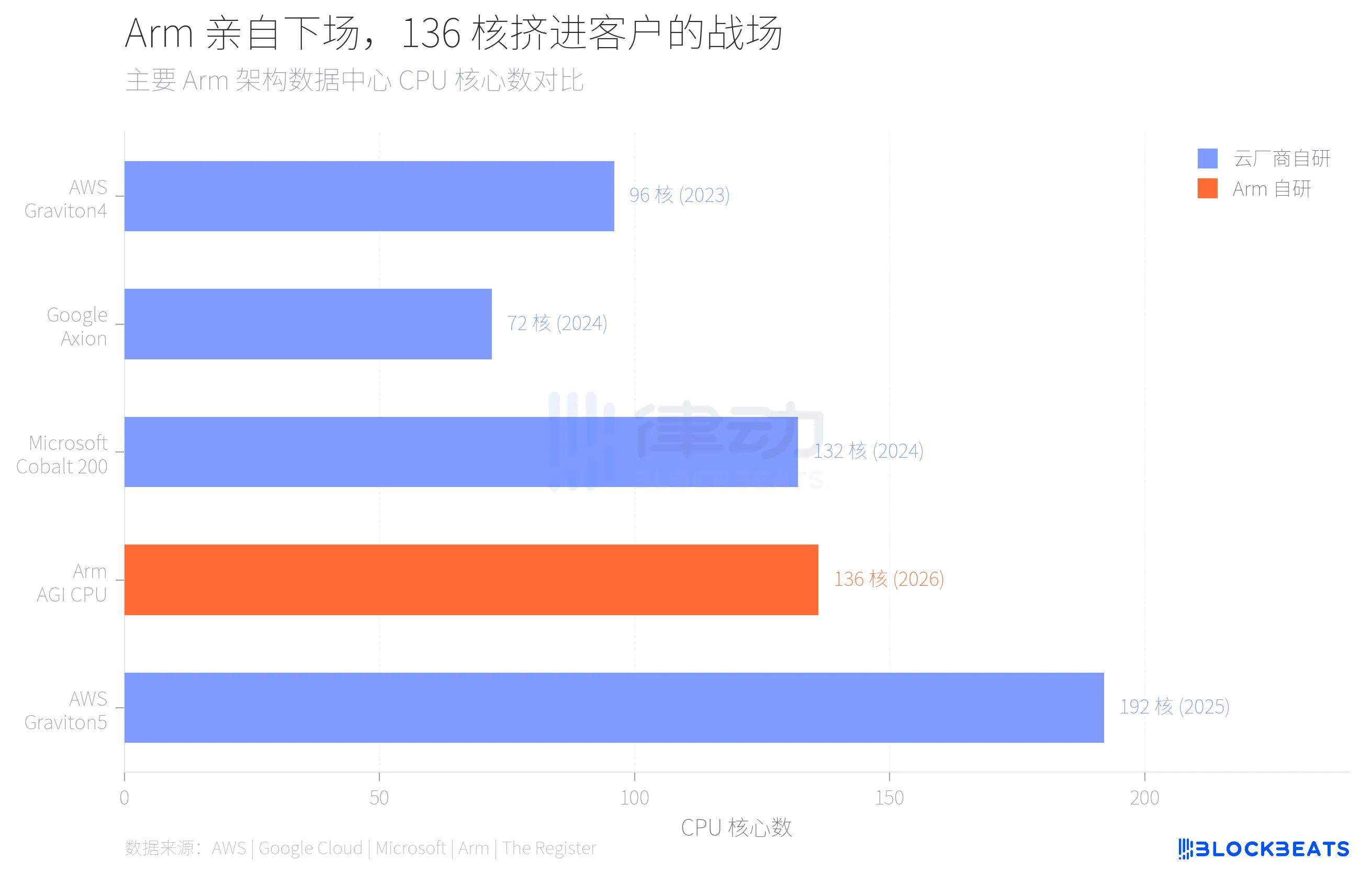
These cloud providers all use Arm's architecture license, but the chips are self-designed, self-fabricated, and self-deployed. Arm earns licensing fees and royalties rather than chip profits. As more and more computing power is consumed by these custom chips, Arm's revenue ceiling in data centers becomes clearer.
Looking at Arm's revenue structure over the past four years, the outline of this ceiling becomes more defined. According to Arm's annual reports, from FY2022 to FY2025, the company's total revenue is projected to grow from $27 billion to $40 billion, with a CAGR of around 14%. Royalty revenue is expected to increase from $15.62 billion to $21.68 billion, while licensing revenue is set to grow from $11.41 billion to $18.39 billion. The growth rate of royalties has slowed to 20% from previous years, and this 20% growth is largely driven by the upgrade to the Armv9 architecture in the mobile sector, not in data centers.
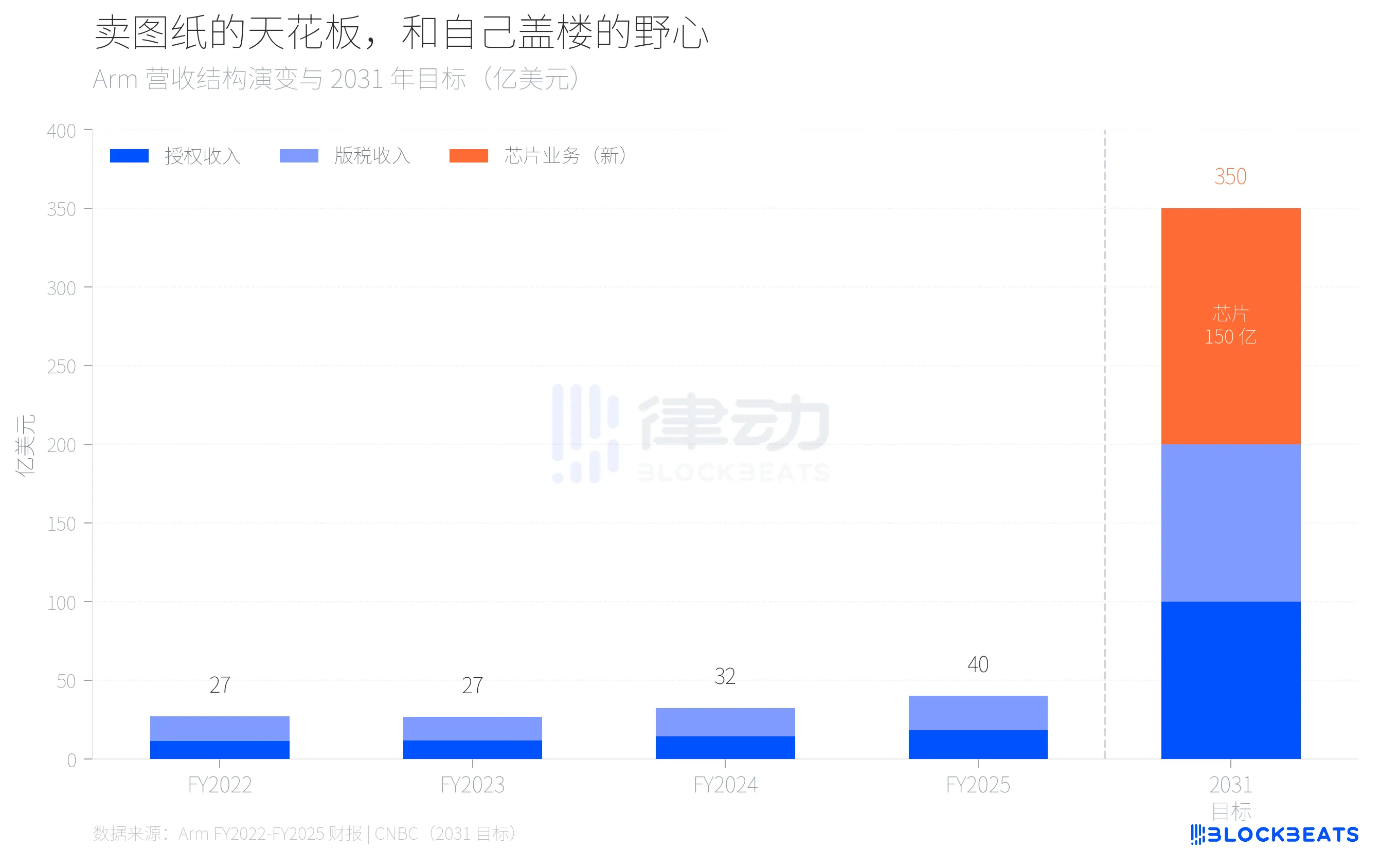
Extrapolating this growth rate, even if both licensing and royalty revenues maintain an annual growth rate of around 20%, by 2031, they will only reach about $10 billion. The remaining $15 billion must come from a business that does not yet exist today. This is the arithmetic logic behind Arm's decision to manufacture its own chips.
Arm's choice to produce its own chips fundamentally means competing with its own customers. A company that sells blueprints to others is now constructing buildings itself, while its blueprint buyers have been building for years.
This is the true background of the 136-core AGI CPU. According to The Register, this chip has a base frequency of 3.2 GHz, up to 3.7 GHz, 12-channel DDR5 memory, 6 GB/s per core bandwidth, 96 PCIe 6.0 lanes, and supports CXL 3.0. Arm positions it as the "computing foundation of the agentic AI cloud era," focusing on CPU-side task scheduling and data flow management in AI inference, rather than directly competing with GPUs.
The pace of market share change also speaks volumes. According to Omdia's estimates, by 2025, Arm architecture servers will account for approximately 21% of global shipments, with a 70% growth rate. However, within hyperscale data centers, this proportion is already close to 50%. The 40-year dominance of x86 is not collapsing but being replaced chip by chip.
The risk of Arm's in-house chip is not technical, but relational. Meta's willingness to be the first customer is partly because Meta itself does not have a mature in-house chip project like Amazon or Google. But how would Amazon, Google, or Microsoft view this? If a supplier starts competing with you, would you still hand over your most critical architecture to them?
Arm's bet is that the overall growth of the data center is faster than the deterioration of customer relationships. Rene Haas apparently believes that the incremental demand for CPUs in the AI era is large enough to allow for both in-house chips and architecture licensing to coexist. The $15 billion target is the pricing of this assessment.
After 35 years of selling blueprints, building their own building for the first time. While they continue to sell blueprints, they are also constructing the building, all on the same plot of land. It remains to be seen whether it will be too crowded.
-- Price
This content is provided for general informational purposes only and doesn't constitute financial, investment, legal, or tax advice. Any events, rewards, online promotions, or related information mentioned herein should not be considered a recommendation, solicitation, or invitation to purchase, sell, trade, or otherwise deal in any crypto assets. Crypto assets are highly volatile and may result in loss. The availability of WEEX services, products, and related events may vary by region. You are responsible for ensuring that your participation is in accordance with applicable local laws and regulations.
You may also like

Grafana: Investigation reveals that recent security incidents have not affected customer production systems and operations
Anthropic signs a $200 billion contract with Google Cloud, Alphabet's market value briefly surpasses Nvidia
Google Cloud and the Solana Foundation launch the AI agent pay-per-use system Pay.sh

Alibaba Cloud: Enterprise-level Agent Construction Platform JVS Crew Launched

0G Foundation has partnered with Alibaba Cloud to launch on-chain access to the Qianwen large model for AI agents
WORLD3 releases AI strategic white paper: has processed over 100 billion LLM tokens
Tencent Cloud Industry Architect Alan Nie: The dual engines of Cloud + AI drive the breakthrough of infrastructure and R&D efficiency bottlenecks in Web3
ChainCatcher Hong Kong Forum officially opens today, focusing on the new paradigm of the integration of cryptocurrency and smart economy
Countdown 5 days | ChainCatcher Hong Kong Forum is about to open, focusing on the new paradigm of the integration of cryptocurrency and smart economy

OpenAI and Anthropic, both pre-IPO, want to keep brawling
South Korean payment giant NHN KCP collaborates with Avalanche to build a payment-dedicated L1 network
The AI payment protocol x402 under Coinbase has joined the Linux Foundation, receiving support from several institutions including Google, Stripe, and AWS
Landscape Fund strategically invests in Zhihui Cloud World, increasing investment in China's AI intelligent computing power infrastructure

Steakhouse Financial: Currently addressing the DNS hijacking attack incident, the front end has not yet recovered but the funds of depositors are safe

HashKey Cloud has launched a three-month fee-waiver plan for staking, helping stakers deal with Ethereum's exit queue delay.
Tariff Clouds Part, Is the Bull Market's Bugle Call Sounding Again?
The Minnesota-based credit union will launch the Cloud Dollar stablecoin
The modular blockchain Origins Network has completed a strategic financing of 8 million USD, with participation from Animoca Brands and others

How a Risk-Controlled AI Crypto Trading Bot Protects Capital in Real Markets
Ritmex demonstrates how disciplined risk control and structured signals can make an AI crypto trading bot more stable and reliable on WEEX, highlighting the importance of combining execution discipline with scalable AI trading systems.
The three major U.S. stock indices fell over 1% on the day of the Federal Reserve's interest rate decision

Analysis: Huang Renxun needs to prove Groq's integration roadmap today, otherwise the custom chip narrative will prevail

Cambridge Research: Bitcoin can withstand a break in global undersea cables below 72%, but targeted attacks on the five major custodial service providers could lead to network paralysis

Anthropic announces $100M investment in partner network Claude

Decentralized cloud infrastructure Akave completes $6.65 million funding, with participation from Avalanche Foundation and others
Alibaba Cloud Launches Clawdbot Full-Service Cloud Solution
Original Content Blocked: Importance of API Management
Key Takeaways: API management is crucial in preventing disruptions due to excessive requests. Implementing effective controls and monitoring…

Is the WEEX AI Trading Hackathon Worth Joining? $1.88M Prize Pool and Rules Explained
An AI trading competition with a $1.88M prize pool — explore WEEX AI Trading Hackathon rules, OpenAPI trading, and AI-only participation requirements.

Payment Going Global: The Honest Man's Endurance Race

NVIDIA to Acquire AI Chip Startup Groq for About $200 Million in Cash, Its Largest Acquisition

How HashKey Intends to Pave the Way as Hong Kong’s Premier Crypto IPO
Key Takeaways HashKey aims to be Hong Kong’s first fully crypto-native Initial Public Offering (IPO), with plans to…
Grafana: Investigation reveals that recent security incidents have not affected customer production systems and operations
Anthropic signs a $200 billion contract with Google Cloud, Alphabet's market value briefly surpasses Nvidia
Google Cloud and the Solana Foundation launch the AI agent pay-per-use system Pay.sh
Alibaba Cloud: Enterprise-level Agent Construction Platform JVS Crew Launched
0G Foundation has partnered with Alibaba Cloud to launch on-chain access to the Qianwen large model for AI agents
WORLD3 releases AI strategic white paper: has processed over 100 billion LLM tokens