
Hyperbeat, to launch a "bank" on Hyperliquid

 Prefer us on Google


Original Title: "Hyperbeat: The Person Behind the 'Bank' on Hyperliquid"
Original Author: Sanqing, Foresight News
On April 8, the Hyperliquid native protocol Hyperbeat launched Liquid Banking, deploying a self-managed "bank" on HyperEVM, integrating stablecoin deposits, VISA card spending, perpetual contract trading, and multi-currency fiat transactions into a single on-chain smart wallet.
Image Source: Hyperbeat Tweet
The Hyperbeat team transitioned from the Hyperliquid testnet's initial validators, starting with only 5 members and self-raising around $200,000 to kick off. The two co-founders, Kilian Boshoff (@Fundi_Crypto) and 800.HL (@degennQuant), have kept a low profile, with the former having a background from Stellenbosch University in South Africa, and the company registered in the Cayman Islands.
In August 2025, they completed a $5.2 million seed round, led by ether.fi Ventures and Electric Capital, with participation from Coinbase Ventures, Maelstrom, Anchorage Digital, among others, valuing the company at around $40 million.
Morpho Powers the Engine, Creating a 'Bank' in Ten Months
The core selling point of Liquid Banking is Credit Mode.
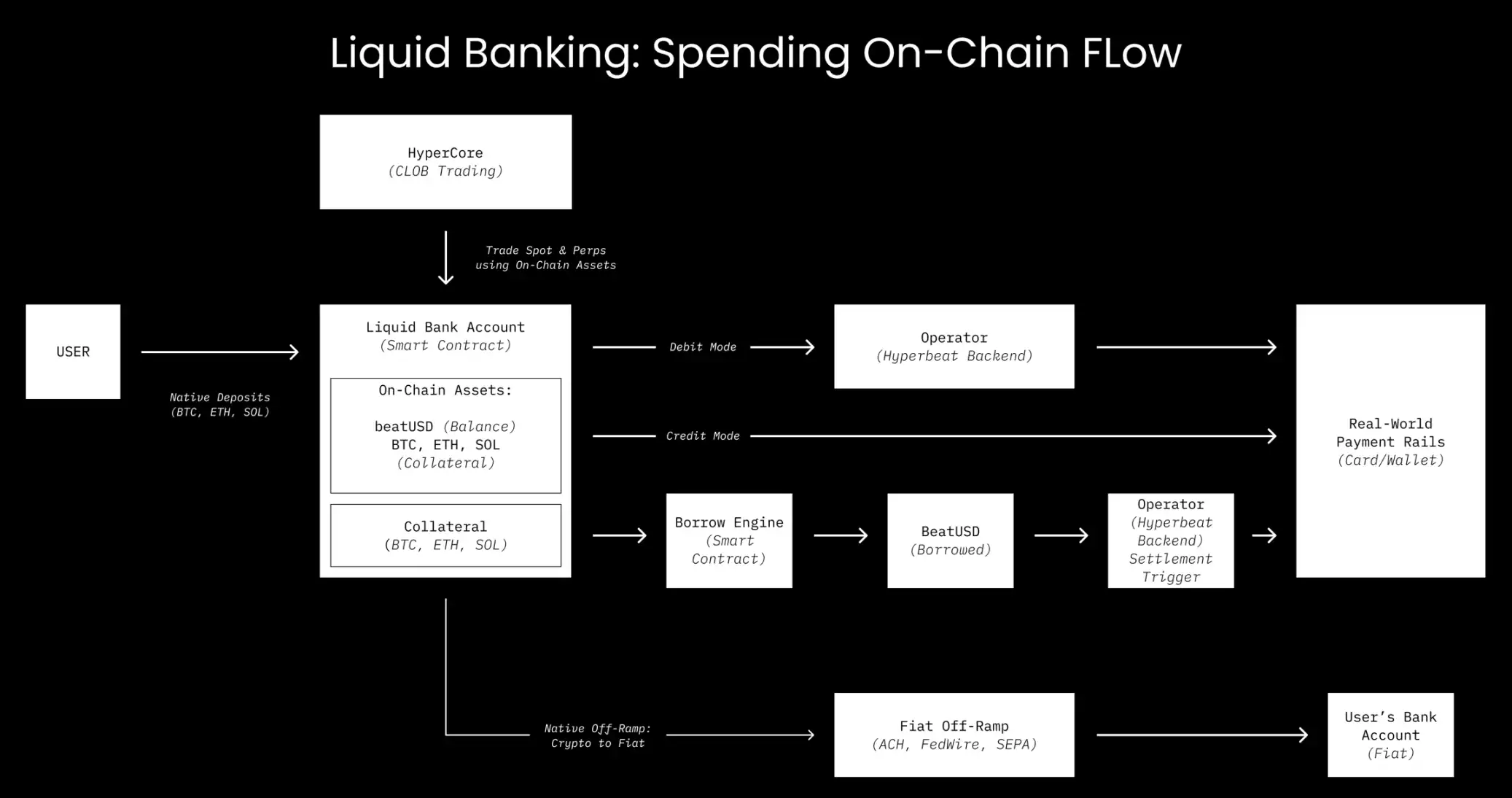
CREDIT Mode | Image Source: Hyperbeat Docs
Users deposit assets such as BTC, ETH, HYPE as collateral, and when they swipe their VISA card, the system instantly borrows stablecoins through the Morpho Blue market to complete the payment, while the collateral remains on-chain to continue earning rewards. Users never interact with a lending interface throughout the process, as the act of swiping the card itself constitutes an on-chain loan.
The underlying lending engine comes from Morpho. Hyperbeat integrates Morpho into users' smart wallets through an on-chain whitelist mechanism. Currently, Credit Mode is running on six isolated markets, with collateral including HYPE, UBTC, UETH, USOL, and even the gold token XAUT.
Hyperbeat does not touch the core lending logic, and Morpho does not touch the user interface. The former creates the "bank frontend," while the latter provides the "credit engine."
The stablecoin deposits in Liquid Banking are centered around the native stablecoin beatUSD issued in collaboration with Paxos Labs. Paxos provides the stablecoin infrastructure (based on USDG0), with reserve earnings flowing directly back into Hyperbeat's reward program and ultimately distributed to users, rather than remaining with the issuer.
The USD+ Treasury on the deposit side automatically allocates user funds to Morpho and protocols like Hypuur, Hyperlend, Felix, offering an annual percentage yield of 3%-8%.
The earnings come from real lending interest from Credit Mode consumers. The more the consumption, the higher the deposit yield. However, whether this cycle can be sustained depends on the actual consumption volume.
Non-selling coin consumption, but card swiping accrues interest
The fiat deposits and withdrawals in Liquid Banking are provided by Noah, supporting USD (ACH, FedWire) and Euro (SEPA) deposits, with each account linked to a unique IBAN.
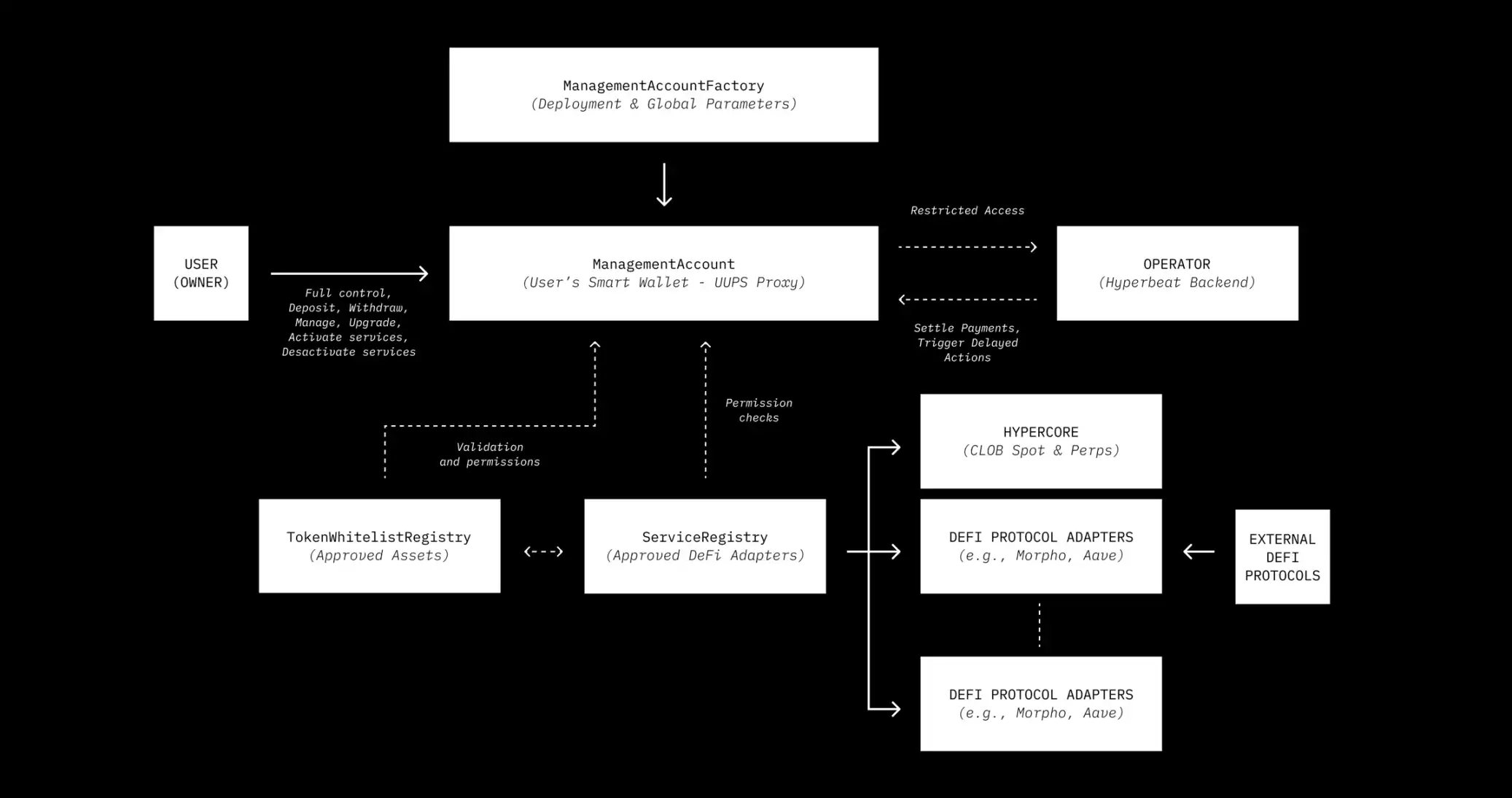
Liquid Banking Architecture | Source: Hyperbeat Docs
In March 2026, direct deposits and withdrawals for the Vietnamese Dong and Malaysian Ringgit will be further enabled, with withdrawals also covering currencies like Pound Sterling, Dirham, Baht, among a dozen others.
The VISA card is issued by Third National, with the underlying infrastructure provided by Rain, a Visa Principal Member. By early January 2026, its funding valuation had reached $1.95 billion, with an annualized processing volume exceeding $30 billion, covering over a hundred countries.
The card is classified as Visa Signature, with benefits such as airport lounge access. Foreign exchange transactions incur a 1% FX fee (based on Visa's official rate), no annual fee, no swipe fees; ATM withdrawals cost $1 + 0.65%; default monthly spending limit of $100,000.
The Credit Mode's lending interest rate fluctuates with the Morpho market utilization rate, but there is no interest-free period; interest on each "HODL & Borrow" transaction starts accruing from the moment of the transaction.
The Hyperbeat official "no hidden fees" refers to the transparency of the yield strategy, not the card fee pricing. The Credit Mode lending interest rate is dynamically determined by the Morpho market, without an interest-free period, meaning that the real-time cost of "HODL & Borrow" convenience exists and is not low.
Self-Custody Comes with a One-Day Cooling-Off Period
Unlike all centralized crypto cards, user assets always stay in their self-controlled ManagementAccount smart wallet. The Hyperbeat backend only has a limited Operator role, which can only settle within the user-set limits and cannot transfer assets to unauthorized addresses.
However, self-custody must address one issue: what if users front-run withdrawals after swiping their card? Hyperbeat has introduced an on-chain time-lock mechanism.
Settlement token withdrawals require a cooling-off period and confirmation process, collateral withdrawals require Operator approval to prevent defaults, and mode switches also have delays. The contract has been audited by Zellic and Nethermind, and key management is provided by Turnkey.
These frictions are not bugs but features. It acknowledges the speed difference between on-chain settlement and offline consumption, filling the gap with contract rules instead of "trust us." However, users must monitor their health factor themselves, as there is no customer service to help undo operational errors.
-- Price
This content is provided for general informational purposes only and doesn't constitute financial, investment, legal, or tax advice. Any events, rewards, online promotions, or related information mentioned herein should not be considered a recommendation, solicitation, or invitation to purchase, sell, trade, or otherwise deal in any crypto assets. Crypto assets are highly volatile and may result in loss. The availability of WEEX services, products, and related events may vary by region. You are responsible for ensuring that your participation is in accordance with applicable local laws and regulations.
You may also like
Aave submitted a governance proposal to the Arbitrum DAO, requesting the release of frozen ETH to be injected into DeFi United

Data: A certain whale has accumulated 19,300 ETH, with an unrealized profit of 1.453 million USD
Cryptocurrency VC collectively boosts presence, is the market starting to bottom out and rebound?

ETHZilla: Currently Holding 102,246 ETH, with a Maximum of $250 Million Available for Stock Buyback

ether.fi Foundation: This week spent 73 ETH from protocol revenue to purchase 264,000 ETHFI tokens

ether.fi bought back over 360,000 ETHFI tokens last week, bringing the total protocol buyback amount to $11.77 million.

SharpLink achieved a net profit of $104.3 million in the third quarter, and its ETH holdings increased to 861,000 coins.

SharpLink is planning to deploy $200 million worth of ETH on the Linea network

Ripple and SBI Team Up for RLUSD Stablecoin Launch in Japan by Early 2026
Latest Crypto Market Snapshot as of August 22, 2025 BTC Soars to $115,250.00 ETH Hits $4,450.75 XRP Climbs…

Judicial Investigation Agency Raids Properties of Alias 'Gato's' Children in Costa Rica Case Expansion
Goldman Sachs backs crypto stocks amid Bitcoin breakout

Fixed-term deposits in dollars: what you earn by investing $2,000
Bitcoin Spot Demand: The Signal That Hadn't Reappeared Since the October 2025 Record
Cofund Maps Over 24 Bitcoin Covenant Use Cases
Purchase of Cryptocurrency Through Intermediaries Will Be Available to Unqualified Investors

Saudi Arabia Leads Mecca Agreement, Oil Dollar System Faces New Trust Test

$1 Billion in 48 Hours: X Prepares Crypto Trading Function on Feed

The forex complex: How retail traders are adapting to volatile 2026 markets
Trump Beats the Fed: How Trading Boom Explodes in the UAE
LayerZero Unveils ATLAS Exchange Engine
Chile Requests the Extradition of Two Venezuelans Who Laundered Nearly USD 19 Million for the Tren de Aragua
Crypto investors should favor systematic strategies over Fed predictions, Moon Pursuit Capital says

MEXC stock futures trading volume in Asia surges over 3,300% in Q2

Operation Lighthouse: 14,000 Leads Delivered to Investigators Against Child Exploitation Networks

Binance founders used ‘The Simpsons’ codenames, former employees share

Crypto: Solana ETFs Record Their Biggest Day of the Year

Ray Dalio Warns of U.S. Debt Crisis and Recommends Gold and Bitcoin as Protection

Xbox and PlayStation Reassess Their Multiplatform Strategy, Emphasizing Exclusivity Again
The new Resident Evil movie will bring action to the first person
What is the cost of cheap borrowing?
Aave submitted a governance proposal to the Arbitrum DAO, requesting the release of frozen ETH to be injected into DeFi United
Data: A certain whale has accumulated 19,300 ETH, with an unrealized profit of 1.453 million USD
Cryptocurrency VC collectively boosts presence, is the market starting to bottom out and rebound?
ETHZilla: Currently Holding 102,246 ETH, with a Maximum of $250 Million Available for Stock Buyback
ether.fi Foundation: This week spent 73 ETH from protocol revenue to purchase 264,000 ETHFI tokens
ether.fi bought back over 360,000 ETHFI tokens last week, bringing the total protocol buyback amount to $11.77 million.

Contents
Latest articles


Latest coin listings on WEEX


