
The $293 million bug wasn't in the code; so, what's the deal with the "DVN Configuration Bug," which led to the largest hack of 2026?

 Prefer us on Google


On April 18, 2026, the liquidity restaking protocol of Kelp DAO was exploited, with the attacker siphoning off 116,500 rsETH from a cross-chain bridge within hours, amounting to approximately $293 million at the time. The entire process was efficiently executed with a hint of anomaly, starting from a forged cross-chain message to laundering the stolen funds across Aave V3, Compound V3, and Euler lending protocols with real assets borrowed. The attacker swiftly exited with $236 million worth of WETH on the same day. Aave, SparkLend, and Fluid promptly froze the rsETH market.
This marks the largest DeFi exploit event of 2026.
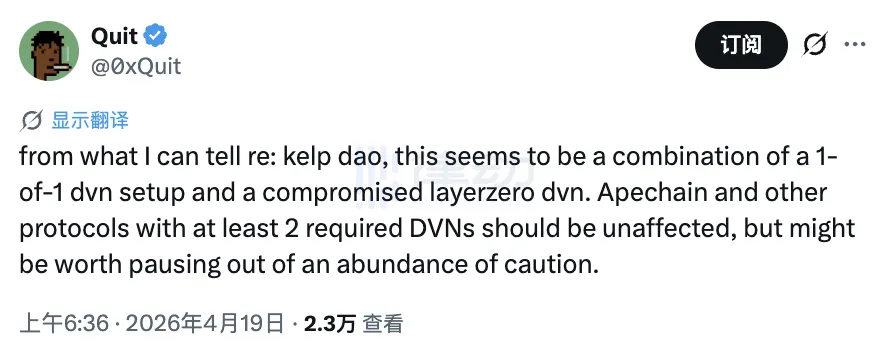
However, one aspect distinguishes this attack from most hacking incidents. The smart contract code of Kelp DAO had no vulnerabilities. Security researcher @0xQuit, involved in the investigation, stated on X, "From what I currently understand, this is a combination of two issues: a 1-of-1 DVN configuration and the compromise of the DVN node itself." In their official statement, LayerZero did not blame the contract code, categorizing the issue as an "rsETH vulnerability" rather than a "LayerZero vulnerability."
$293 million was not in any line of code. It was concealed within a misconfigured parameter during deployment.
The common logic behind DeFi security audits is: find the contract, read the code, find vulnerabilities. This logic operates quite smoothly when dealing with code logic vulnerabilities. Tools like Slither and Mythril are mature in detecting known patterns such as reentrancy attacks and integer overflows. The widely promoted LLM for assisting in code audits also has some capability in identifying business logic vulnerabilities (e.g., flash loan arbitrage paths).
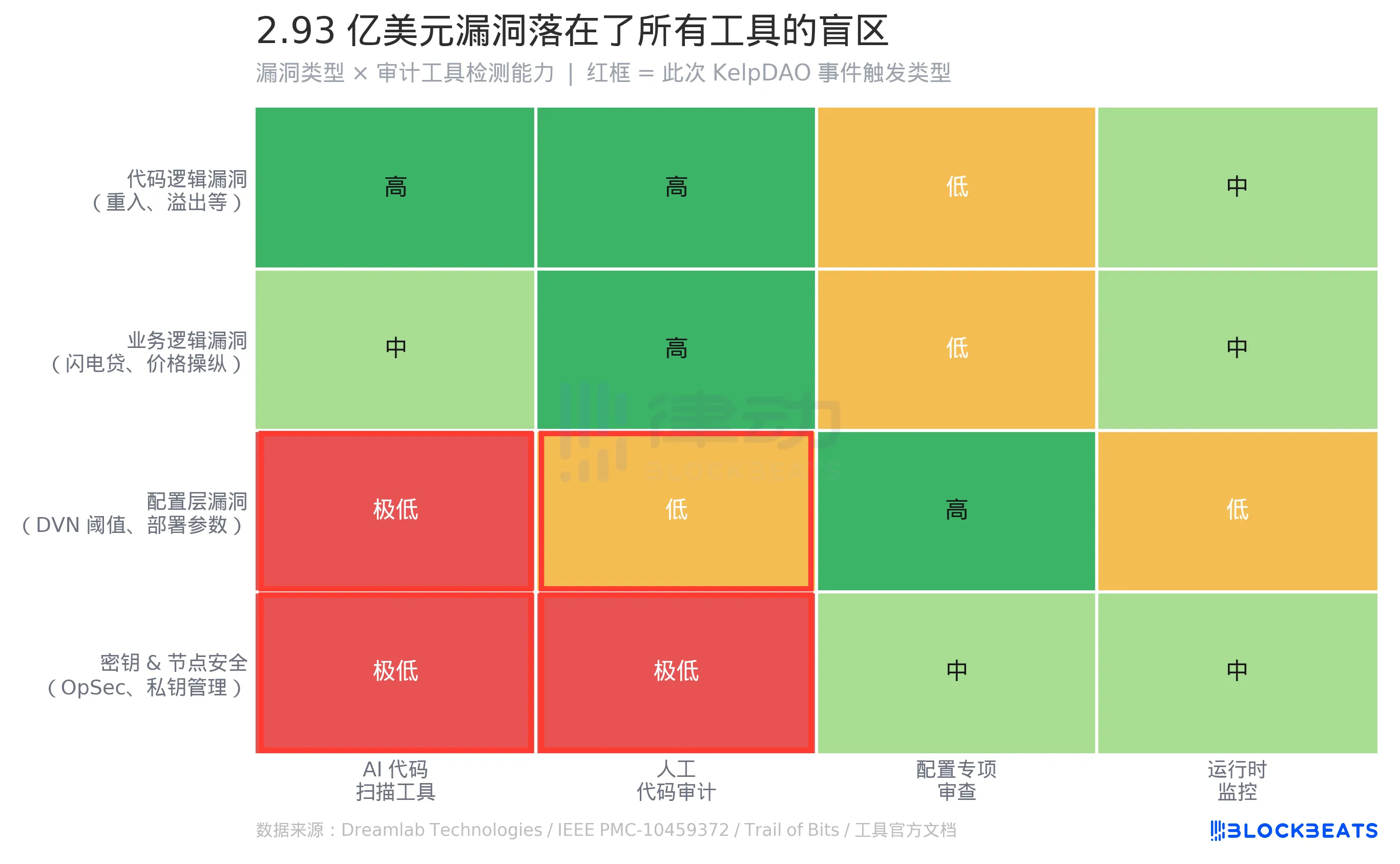
However, in this matrix, two rows are marked in red.
Configuration-level vulnerabilities fall into a structural blind spot in tool-based audits. The issue with Kelp DAO was not in a .sol file but in a parameter—DVN threshold—written during protocol deployment. This parameter determines how many validating nodes a cross-chain message must pass through to be considered valid. It's not in the code, not within Slither's scanning scope, nor in Mythril's symbolic execution path. According to Dreamlab Technologies' comparative study, Slither and Mythril detected 5/10 and 6/10 vulnerabilities in the tested contract, respectively. However, these results are based on the premise that the vulnerabilities exist in the code. According to IEEE research, even at the code level, existing tools can only detect 8%-20% of exploitable vulnerabilities.
From the perspective of the current audit paradigm, there is no tool that can "detect whether the DVN threshold is reasonable." To detect this type of configuration risk, what is needed is not a code analyzer, but a specialized configuration checklist: "Is the number of DVNs for the cross-chain protocol ≥ N?" "Is there a minimum threshold requirement?" Such questions are currently not covered by standardized tools and there is no widely recognized industry standard.
Also within the red zone is key and node security. In @0xQuit's description, it is mentioned that a DVN node was "compromised," which falls under Operational Security (OpSec) and is beyond the detection boundary of any static analysis tool. Whether it is a top-tier auditing firm or an AI scanning tool, none have the ability to predict whether a node operator's private key will be leaked.
This attack simultaneously triggered two red zones in the matrix.
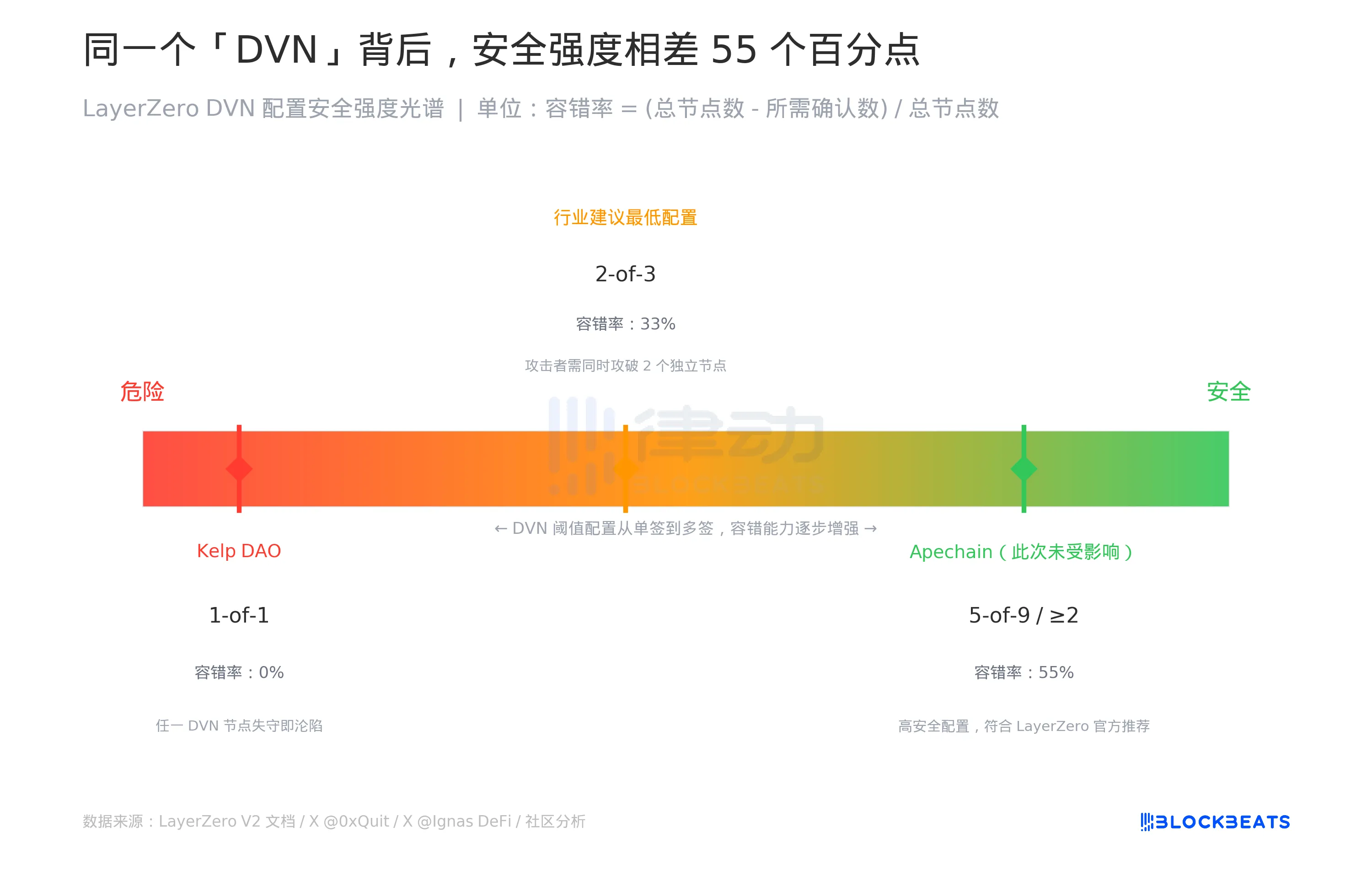
DVN is the cross-chain message verification mechanism of LayerZero V2, fully named Decentralized Verifier Network. Its design philosophy is to entrust security decision-making to the application layer: each protocol connecting to LayerZero can choose the number of DVN nodes required to confirm before allowing a cross-chain message to pass.
This "flexibility" has created a spectrum.
Kelp DAO chose the far-left end of the spectrum with a 1-of-1, requiring only one DVN node to confirm. This means a fault tolerance of zero, as an attacker only needs to compromise that single node to forge any cross-chain message. In contrast, Apechain, also connected to LayerZero, configured more than two required DVNs and was not affected by this event. The wording in the LayerZero official statement was, "All other applications remain secure," implying that security depends on the selected configuration.
The standard industry recommendation is at least 2-of-3, where an attacker would need to compromise two independent DVN nodes simultaneously to forge a message, increasing fault tolerance to 33%. A high-security configuration like 5-of-9 can raise fault tolerance to 55%.
The issue is that external observers and users cannot see this configuration. Also known as being "supported by LayerZero," the backend could range from 0% fault tolerance to 55% fault tolerance, both referred to as DVN in the documentation.
Seasoned crypto investor Dovey Wan, who experienced the Anyswap incident, directly stated on platform X: "LayerZero's DVN turned out to be a 1/1 validator... All cross-chain bridges should immediately undergo a comprehensive security review."
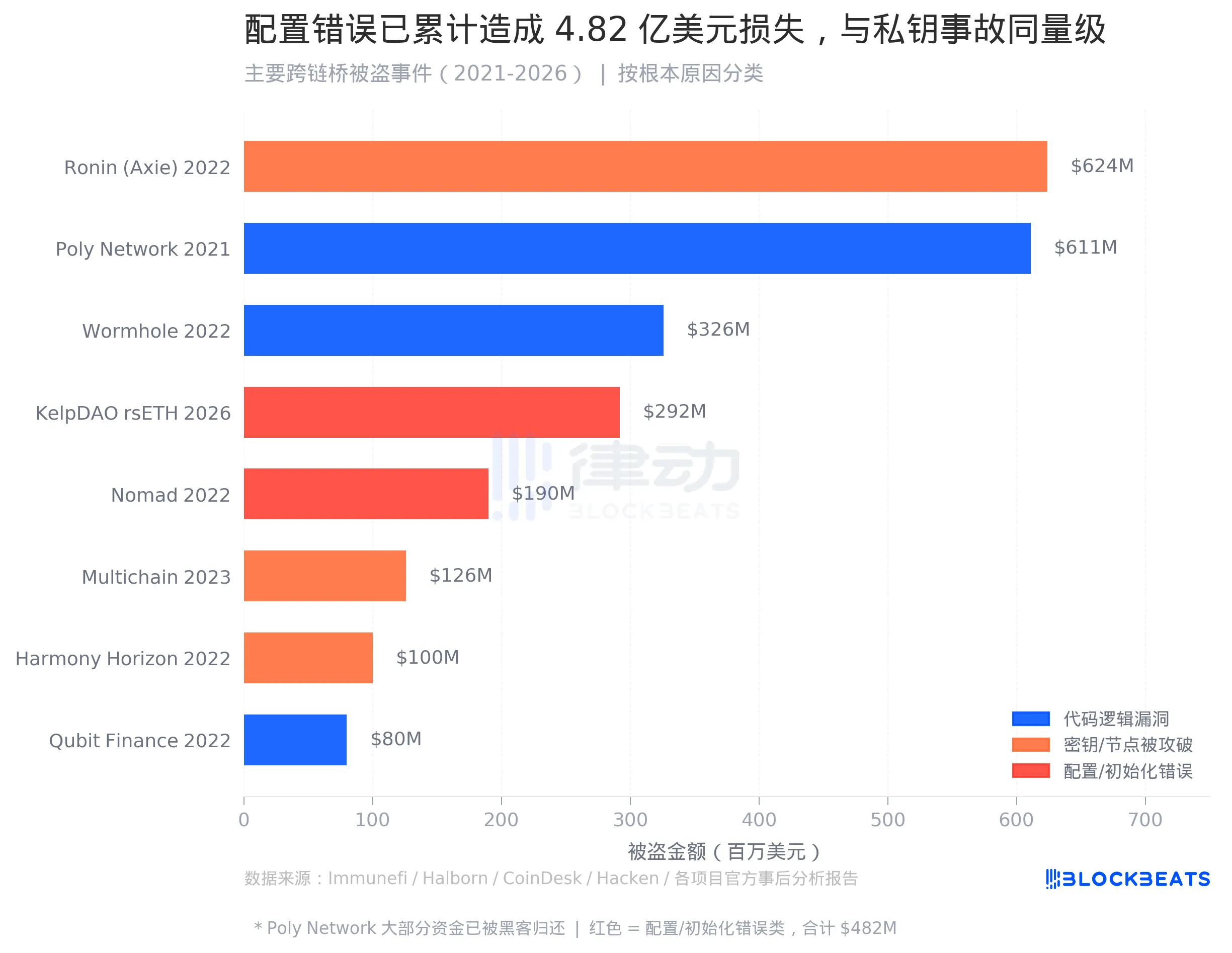
In August 2022, a vulnerability was discovered in the Nomad cross-chain bridge. Someone replicated the initial attack transaction, made minor modifications, and found success, leading to hundreds of addresses replicating the exploit and draining $190 million in a matter of hours.
Postmortem analysis by Nomad attributed the vulnerability to "initializing the trusted root as 0x00 during a routine upgrade." This was a configuration error that occurred during the deployment phase. The Merkle proof validation logic and the code itself were sound; the issue stemmed from an incorrect initial value.
Combining this incident with previous ones involving Nomad, configuration/initialization vulnerabilities have now resulted in approximately $482 million in losses. In the history of cross-chain bridge exploits, this category's scale now rivals that of key exposure incidents (e.g., Ronin $624 million, Harmony $100 million, Multichain $126 million, totaling around $850 million).
However, the product design of the code auditing industry has never been focused on this category of vulnerabilities.
Most discussions in the industry still revolve around code logic bugs. Incidents like Wormhole's $326 million exploit due to signature verification bypass and Qubit Finance's $80 million loss due to a fake deposit event are well-analyzed with detailed vulnerability reports, CVE references, and reproducible PoCs, making them suitable for audit tool training and optimization. Configuration layer issues are not explicitly coded, making it challenging to address within the production cycle.
One notable detail is the distinct triggering mechanisms of the two configuration-related events. Nomad's error stemmed from inadvertently setting an incorrect initial value during a routine upgrade, constituting a mistake. On the other hand, Kelp DAO's 1-of-1 incident was an active configuration choice—LayerZero protocol did not prohibit this option, and Kelp DAO did not violate any protocol rules. A "compliant" configuration choice and a "mistaken" initial value both led to the same outcome in the end.
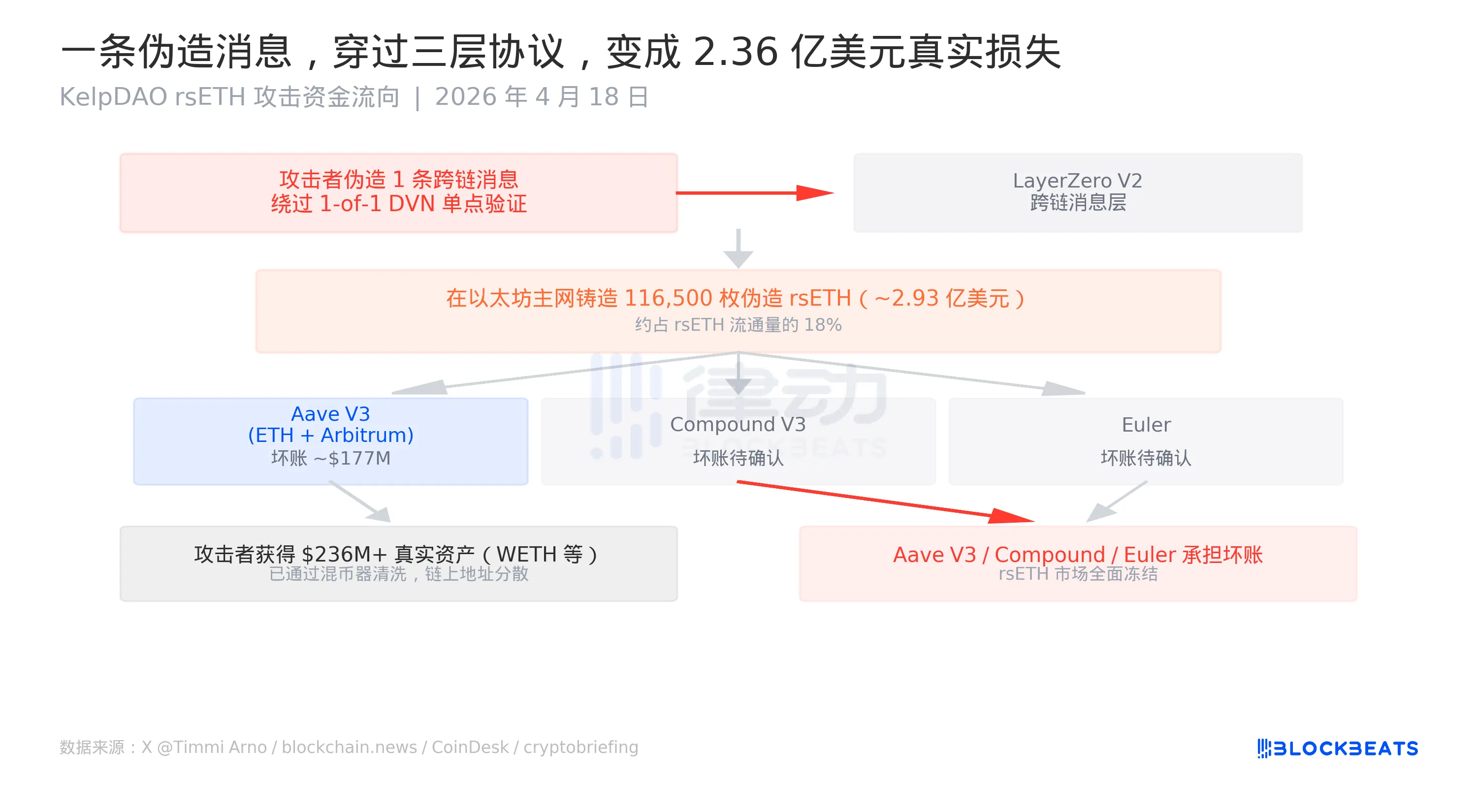
The execution logic of this attack was straightforward. A forged cross-chain message informed the Ethereum mainnet that "someone had already locked up an equivalent asset on another chain," triggering the minting of rsETH on the mainnet. The minted rsETH itself had no real backing, but its on-chain record was "valid" and could be accepted by lending protocols as collateral.
The attacker then dispersed 116,500 rsETH to Aave V3 (Ethereum and Arbitrum), Compound V3, and Euler, borrowing over a total of $236 million in real assets. According to multiple sources, the standalone default estimate for Aave V3 is around $177 million. Aave's security module Umbrella, used to absorb default losses, has a WETH reserve of around $50 million with a coverage ratio of less than 30%, with the remaining amount to be borne by aWETH stakers.
This ultimately falls on those who simply wanted to earn some WETH interest.
As of the time of writing, LayerZero is still conducting a joint investigation with the security emergency response organization SEAL Org and plans to release a post-incident analysis report in collaboration with Kelp DAO once all information is obtained. Kelp DAO has stated that they are working on "active remediation."
The $293 million exploit is not in the code. The phrase "audit passed" did not cover the location of that parameter.
-- Price
This content is provided for general informational purposes only and doesn't constitute financial, investment, legal, or tax advice. Any events, rewards, online promotions, or related information mentioned herein should not be considered a recommendation, solicitation, or invitation to purchase, sell, trade, or otherwise deal in any crypto assets. Crypto assets are highly volatile and may result in loss. The availability of WEEX services, products, and related events may vary by region. You are responsible for ensuring that your participation is in accordance with applicable local laws and regulations.
You may also like

Chainlink unlocks DeFi lending for Coinbase tokenized stocks

LayerZero Aims to Become the Invisible Exchange of Finance, ZRO Surges by 30%
LayerZero Unveils ATLAS Exchange Engine

USDG0 Expands Multi-Chain Distribution Based on LayerZero

BitGo Changes $7.3 Billion WBTC Cross-Chain Service Provider to Chainlink CCIP

Circle's Public Blockchain Arc Appears to Be Live, Not Publicly Tested

Aave faced a withdrawal surge of $8.45 billion during the rsETH crisis, reigniting debates about the risk management capabilities of DeFi

FTX/Alameda Wallet Transfers Over $8 Million in ZRO Tokens to Wintermute
Key Takeaways An FTX/Alameda-associated wallet moved 4.126 million ZRO tokens to market maker Wintermute, with an approximate value…
North Korea’s $500M DeFi Heist Unveils New Cyber Warfare Tactics
Key Takeaways: North Korean operatives have obtained over $500 million from DeFi platforms in under three weeks. The…

DeFi Losses Top $600 Million Amid Kelp DAO Exploit and TVL Decline
Key Takeaways: Total DeFi losses have skyrocketed to approximately $1 billion recently, with $600M+ linked directly to the…

Kelp DAO Exploit Fallout Deepens as Attacker Routes $175M in ETH via Privacy Rails
Key Takeaways: The attacker moved $175 million in stolen ETH to new wallets using privacy tools. The exploit…

LayerZero releases KelpDAO security incident report: will adjust security policies and rebuild affected cloud infrastructure

Why is a16z Crypto raising another $2.2 billion to heavily invest in Web3?

LayerZero CEO counters KelpDAO: rsETH initially used the default configuration, then manually switched to the not recommended 1/1 configuration
Kelp DAO abandoned LayerZero after the attack incident and switched to Chainlink's cross-chain infrastructure

Analyst: The attacker of the Wasabi protocol has transferred all stolen funds to Tornado Cash
The billion-dollar lesson: The focus of DeFi security is shifting from code to operational governance
Blockchain trading platform Ekiden has completed a $2 million seed round financing, with participation from Unicorn Factory Ventures and others
Morning Report | Visa includes Polygon in its global stablecoin settlement program; MoonPay invests $100 million to acquire security company Sodot; Digital wallet platform Belo completes $14 million Series A financing
KelpDAO injects 2000 ETH into the DeFi United Recovery Fund to advance the rsETH recovery plan
Encrypted data and research platform Blockworks completes Series A extension financing with a valuation of $192 million, led jointly by Parafi Capital and Reciprocal Ventures

DeFi United announced the technical solution for the Kelp rsETH vulnerability, planning to liquidate approximately 107,000 tokens from the attacker’s position

LayerZero promises to provide DeFi United with over 10,000 ETH, including a donation of 5,000 ETH

DeFi United raised over 300 million dollars
DeFi United rescue latest progress: over 100,000 ETH raised
How to balance risk and return in DeFi yields?

Aave announces the establishment of a recovery fund to promote full asset-backed recovery of rsETH
The DeFi United ecological rescue operation has raised over 69,618 ETH, worth approximately 161 million USD
Aave leads DeFi "patching" stop-loss, due to KelpDAO being hacked for $292 million in a chain reaction
Lido proposes to use up to $5.8 million in stETH to fill the funding gap for Kelp
Chainlink unlocks DeFi lending for Coinbase tokenized stocks
LayerZero Aims to Become the Invisible Exchange of Finance, ZRO Surges by 30%
LayerZero Unveils ATLAS Exchange Engine
USDG0 Expands Multi-Chain Distribution Based on LayerZero
BitGo Changes $7.3 Billion WBTC Cross-Chain Service Provider to Chainlink CCIP
Circle's Public Blockchain Arc Appears to Be Live, Not Publicly Tested
Contents
Latest articles





Latest coin listings on WEEX


