
Soros Predicts AI Bubble: We Live in a Self-Validating Market

 Prefer us on Google


Original Article Title: Busting the myth of efficient markets
Original Article Author: Byron Gilliam
Original Article Translation: AididiaoJP, Foresight News
How do financial markets, in turn, shape the reality they are supposed to measure?
There is a world of difference between rational 'knowing' and experiential 'understanding.' This is like reading a physics textbook versus watching "Mythbusters" blow up a water heater.
The textbook will tell you: heating water in a closed system will create hydraulic pressure due to water expansion.
You understand the theory of phase transitions from the text.
But "Mythbusters" shows you: how pressure can turn a water heater into a rocket, launching it 500 feet into the air.
You watch the video, and only then do you truly grasp what a catastrophic steam explosion looks like.
Visualization is often more impactful than narration.
Last week, Brian Armstrong gave us a live demonstration of George Soros's "reflexivity theory," an effect that would make the "Mythbusters" team proud.
During Coinbase's earnings call, after answering analysts' questions, Brian Armstrong read out an additional string of words. These were the words that market participants were betting he might say.
He concluded the call by saying: "I have been keeping an eye on the prediction markets for our earnings call. And now, I just wanted to add a few words: Bitcoin, Ethereum, Blockchain, Staking, and Web3."
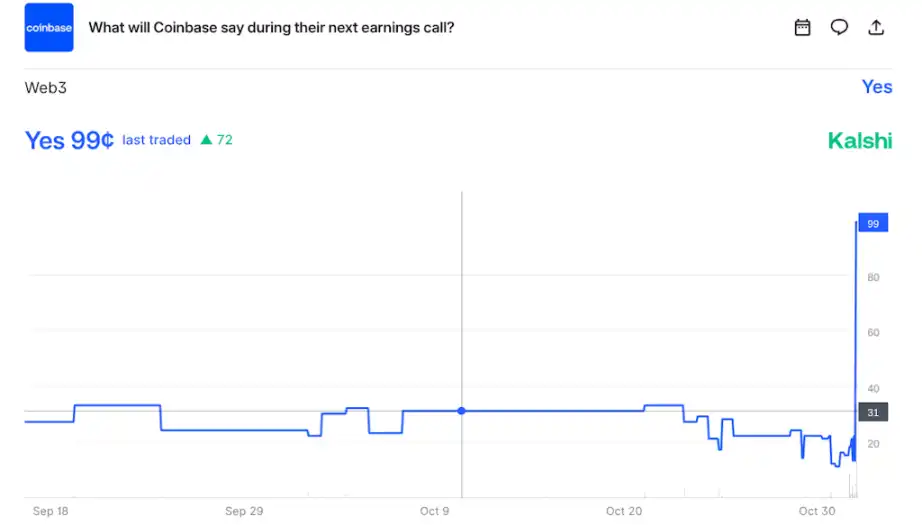
In my view, this vividly illustrates how most financial markets operate, just as George Soros's theory suggests: Market prices will affect the value of the assets they are pricing.
Before becoming a billionaire hedge fund manager, Soros aspired to be a philosopher. He attributed his success to identifying a flaw in the "efficient market theory": "Market prices always distort fundamentals."
Financial markets do not simply passively reflect the fundamentals of assets as traditionally understood; they actively shape the reality they are supposed to measure.
Soros gave the example of the 1960s conglomerate craze: Investors believed that these companies could create value by acquiring small, high-quality companies, driving up their stock prices. This, in turn, allowed these conglomerates to actually acquire these companies using their inflated stock prices, thus "realizing" value.
In short, this created a "sustained and circular" feedback loop: Participants' ideas influenced the events they were betting on, and these events, in turn, influenced their ideas.
Fast forward to today, Soros might give the example of a company like MicroStrategy. Its CEO, Michael Saylor, is pitching to investors exactly this circular logic: You should value MicroStrategy's stock at a premium to its net asset value because the very act of trading at a premium makes the stock more valuable.
In 2009, Soros wrote that he used reflexivity theory to analyze and pointed out that the root cause of the financial crisis was a fundamental misjudgment, namely, the belief that "(real estate) mortgage value is unrelated to credit availability."
The mainstream view was that banks simply overestimated the value of real estate serving as loan collateral, and investors paid too high a price for derivative products supported by these loans.
Sometimes that was indeed the case, just a simple mispricing of assets.
But Soros believed that the massive scale of the 2008 financial crisis had to be explained by a "feedback loop": Investors' high-price purchases of credit products drove up the value of the underlying collateral (real estate). "As credit becomes cheaper and more available, economic activity heats up, causing real estate values to rise."
And the rising real estate values, in turn, encouraged credit investors to pay a higher price.
In theory, credit derivative product prices such as CDOs should reflect real estate values. But in reality, they were also helping create these values.
That, at least, is the textbook explanation of Soros's theory of financial reflexivity.
But Brian Armstrong went beyond mere explanation; he demonstrated it in action, in the way of "The Rumor Terminator."
By speaking the words people were betting he would say, he proved that participants' views (predicting the market) could directly shape outcomes (what he actually said), precisely the meaning of Soros's statement that "market prices can distort fundamentals."
The current AI bubble is a trillion-dollar upgrade to Brian Armstrong's experiment, allowing us to grasp this lesson in real-time: People believe AGI will be achieved, so they invest in OpenAI, NVIDIA, data centers, and so on. These investments make AGI more likely to come true, which in turn attracts more investment in OpenAI...
This perfectly captures Soros's famous insight on bubbles: He would enter the market because his buying would drive up prices, and higher prices would improve fundamentals, attracting even more buyers.
However, Soros would also caution investors against believing in this self-fulfilling prophecy. In the extreme case of a bubble, the speed at which investors drive up prices far exceeds the speed at which prices can improve fundamentals.
Reflecting on the financial crisis, Soros wrote: "A complete reflexive process, initially self-reinforcing, must eventually reach a peak or turning point, after which it becomes self-reinforcing in the opposite direction."
In other words, trees don't grow to the sky, and bubbles don't last forever.
Unfortunately, there is no "MythBusters" type of experiment that can demonstrate this in real life.
But at least now we know that market prices can make things happen, just like a few words spoken on an earnings call.
So, why wouldn't AGI (Artificial General Intelligence) do the same?
-- Price
This content is provided for general informational purposes only and doesn't constitute financial, investment, legal, or tax advice. Any events, rewards, online promotions, or related information mentioned herein should not be considered a recommendation, solicitation, or invitation to purchase, sell, trade, or otherwise deal in any crypto assets. Crypto assets are highly volatile and may result in loss. The availability of WEEX services, products, and related events may vary by region. You are responsible for ensuring that your participation is in accordance with applicable local laws and regulations.
You may also like

Amazon and NVIDIA to Supply 2 Million GPUs for AI Between 2027 and 2028

Sberbank Launches Loans Secured by Ethereum and Tether

EIP-8141 Under Review as a Candidate for the Hegotá Upgrade

Base Tokenized US Treasury Market Sees $636,000 Increase in Market Cap
NFT sales fall 44.7% to $63.3M as Ethereum leads

Polygon Labs issues urgent client upgrade notice following Austin and Kyoto hardforks
Ethereum Supply Increases by 21,125 ETH Over 7 Days
Holder Revenue Reaches $12.938 Million, Emerging as a Benchmark in the DeFi Market

Cosmos misjudged a critical bug for 4 months before hackers stole nearly $6 million across 6 chains

Tokenized gold is becoming productive collateral in crypto lending, Arch says
Hyperliquid Traders Exceed 400,000

Brazil's Federal Revenue Service Reports Cryptocurrency Volume of R$ 283 Billion in the First Half of 2026

The Sandbox to Repay 1:1 SAND After Exploit

Goolsbee Notes Inflation Duration Longer Than Expected
Three Avalanche ETFs Introduce Staking Reward Distribution Structure
Altcoin Trading Volume Reaches 65%, Contrasting with Futures Market Trends

Injective Expands Support for Over 60 Chains in Partnership with LI.FI

Bitcoin ETF Net Assets Surpass $100.9 Billion

US Spot Ethereum ETF Sees $225.8 Million Net Inflow in a Single Day, Hitting 10-Month High
Lido Expands Ethereum Staking Credibility with Web3SOC Certification

Spark Launches New Domain spark.finance, Integrates Lending Features
Coinbase: "Finance Was Built for People Who Sleep"
Nillion Launches First Phase of Encrypted Markets Dusk on Sepolia Testnet

Ethereum and Solana Fees Covered by Intermediaries
Why Coinbase is Betting Big on Agentic Finance

Rayls Launches Private Blockchain Sovereign for Financial Institutions

Wall Street Increases Presence in Crypto, but Altcoin Capital Flows Become More Concentrated

TRON Proposal No. 107 Takes Effect, TVM Compatible with Prague and Osaka Features

The Gap Between South Korea and the Global Crypto Market Has Widened Since Four Years Ago

Solana Faces a Choice: Preserve Staking or Rarify SOL?
Amazon and NVIDIA to Supply 2 Million GPUs for AI Between 2027 and 2028
Sberbank Launches Loans Secured by Ethereum and Tether
EIP-8141 Under Review as a Candidate for the Hegotá Upgrade
Base Tokenized US Treasury Market Sees $636,000 Increase in Market Cap
NFT sales fall 44.7% to $63.3M as Ethereum leads
Polygon Labs issues urgent client upgrade notice following Austin and Kyoto hardforks


