
Massive Bitcoin Sale: Jim Cramer Says He Wants to Sell His BTC

 Prefer us on Google

The Boy Who Cried Wolf. Aesop's fable finds a new avatar on CNBC: after so many false alerts, no one reacts when the warning, this time, might come with a bit more substance. On July 30, Jim Cramer hosted Arvind Krishna, the CEO of IBM, on his show Mad Money on CNBC. He asked him if quantum computing could one day break the cryptography that protects cryptocurrencies. Three days later, on August 3, the host announced he wanted to sell all of his bitcoin. This is yet another turnaround in a long series dating back to 2017, to the point of giving rise to a stock market indicator in its own right: the inverse Cramer. Key points of this article: * Jim Cramer expressed his intention to sell his bitcoin, raising doubts due to his history of reversals. * IBM CEO Arvind Krishna expressed concerns about the potential impact of quantum computing on the security of cryptocurrencies in three to four years. Three to four years against quantum In the July 30 show, reported by TheStreet, Krishna responded that we should give ourselves three or four years, and by that time, he would start to become rather paranoid about the subject. The mechanism he refers to is concrete. Bitcoin relies on a signature algorithm, ECDSA, where the public key, once revealed on the blockchain, could theoretically allow a sufficiently powerful quantum computer to deduce the private key using Shor's algorithm. Millions of bitcoins stored in old addresses have already exposed their public key. This makes them theoretically more vulnerable than addresses that have never been used for spending. Fundamentally, the warning is neither new nor delusional. Indeed, a Google Quantum AI research published in March 2026 reduced the estimate of the number of qubits needed to break this cryptography by a factor of 20, below 500,000 physical qubits. IBM aims for commercially significant quantum applications around 2028-2029, a timeline consistent with the window cited by Krishna. Current machines are still far from the mark, limited to a few thousand physical qubits and a handful of error-tolerant logical qubits. A decision, and a bitcoin we've never seen Cramer has never disclosed the size of his position nor associated any wallet with his name, and no blockchain analysis company tracks him. Therefore, it is impossible to verify whether he actually owns bitcoins, let alone the amount. This is where the story diverges from the buy signal narrative circulating elsewhere: before discussing the market, it should first be established that there is a seller. Indeed, Cramer's journey with bitcoin resembles a documented weather vane for nearly ten years. In December 2017, during the first surge towards $20,000, he called bitcoin monopoly money and advised against touching it. Then, in September 2020, he bought it around $10,000. Later, in June 2021, he sold most of his position citing the Chinese crackdown on mining, just months before bitcoin reached a new record close to $70,000. In January 2024, he announced a nasty crash on the eve of the launch of American spot bitcoin ETFs; the subsequent pullback lasted only a few weeks. A year later, in January 2025, he described bitcoin as a good asset to hold in a portfolio. Just last month, he referred to it as bad money liquidated in favor of stocks like SpaceX, Apple, or Nvidia. August 2026 marks his fifth reversal in less than nine years. Bitcoin is not his only ground for false alerts. On February 8, 2023, Cramer claimed that Silicon Valley Bank was undervalued and that Wall Street was wrongly worried about its situation. A month later, the bank collapsed in the second-largest bank failure in U.S. history at the time. The inverse indicator against a bitcoin that shrugs its shoulders The market did not wait to verify Cramer's wallet to react in its own way. An ETF, the Inverse Cramer Tracker ETF (SJIM), was even launched in 2023 to systematically bet against his public recommendations, before closing in early 2024 due to insufficient assets. Bitcoin, meanwhile, was trading around $64,270 at the time of the August 3 announcement, resisting both Cramer's alert and the $120 million hack of the Coldcard hardware wallet, as well as the rise in bond rates. A signal that the Journal du Coin has seen repeat several times in recent years, with a history that tends to favor the mockers rather than Cramer himself. The real question raised by the episode is not whether Cramer is right or wrong about quantum, but whether the sector is taking the migration to post-quantum encryption standards seriously enough. Several technical teams are already working on improvement proposals for Bitcoin in this regard.
-- Price
This content is provided for general informational purposes only and doesn't constitute financial, investment, legal, or tax advice. Any events, rewards, online promotions, or related information mentioned herein should not be considered a recommendation, solicitation, or invitation to purchase, sell, trade, or otherwise deal in any crypto assets. Crypto assets are highly volatile and may result in loss. The availability of WEEX services, products, and related events may vary by region. You are responsible for ensuring that your participation is in accordance with applicable local laws and regulations.
You may also like

Andrew Kang's Shareholder Letter: Robotics Investment Reaches a Turning Point, Private Valuations Still Severely Lagging

Bitcoin Spot Demand: The Signal That Hadn't Reappeared Since the October 2025 Record
Vietcombank Warns of AI-Driven Fraud

$1 Billion in 48 Hours: X Prepares Crypto Trading Function on Feed

The forex complex: How retail traders are adapting to volatile 2026 markets

Trump Beats the Fed: How Trading Boom Explodes in the UAE

Crypto investors should favor systematic strategies over Fed predictions, Moon Pursuit Capital says

Crypto: Solana ETFs Record Their Biggest Day of the Year

Xbox and PlayStation Reassess Their Multiplatform Strategy, Emphasizing Exclusivity Again

Interview: Aptos CEO on AI Agents, Stablecoins, and Machine Commerce

BlackRock Lowers Minimum Investment for Bitcoin ETF to $1 Million
Previously Bearish on Crypto Market, Jiang Zhuoer Quickly Turns Bullish: Ethereum is the Engine of the Bull Market

Michael Saylor Targets Bitcoin Orthodoxy: 'Satoshi Is Not a Prophet'

Strive by Vivek Ramaswamy Becomes the 7th Largest Public Holder of Bitcoin

The Best AI Models for Trading: A Comparison of the Top 10 Models
Enflame, the Chinese competitor of Nvidia in AI chips, goes public

AI is in a Credit Expansion Phase: The Stronger AI Becomes, the More the Federal Reserve Needs to Cut Rates

Short-Term U.S. Treasury Holdings Decrease by $29 Billion, Testing Demand for Stablecoins

Analysis of Mining Machine Asset Depreciation and Tax Cost Recovery
Bitcoin Transfer by Metaplanet: Sale or Just Custody on Coinbase?
Opinion: The Bull Market Has Arrived, How to Position in This Cycle?
80% of Gas Stations in Russia Face AI-95 Gasoline Shortage
Bitcoin Bull Run: Arthur Hayes Sees Crypto Market Soaring Higher

Goldman Sachs Optimistic About Crypto Brokerage Trading Platforms: Can the Market Support a New Cycle?
Strive CEO: The Bitcoin Bull Market Has Just Begun, ASST Has Passed Its Bottom
Ravencoin (RVN) Price Forecast for 2026–2050

AI Agent's 'Coming of Age': What Step Is Missing from Simulation Training to Real Trading?
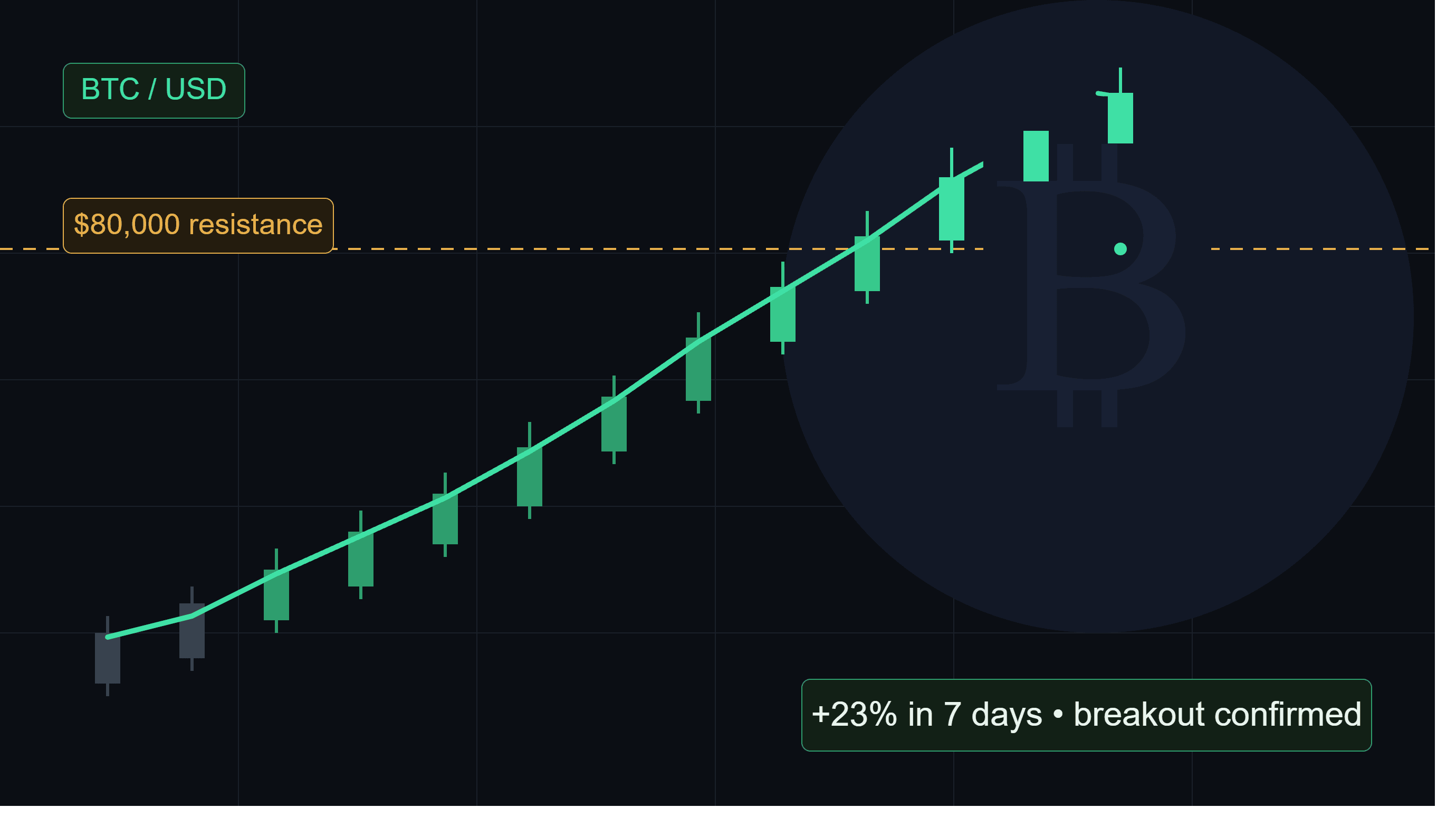
Bitcoin Just Hit $80,000: Last Week WEEX's Prediction Came True — What's Next?
Bitcoin hit $80,000 as WEEX predicted last week. See what drove the breakout, current key levels, and whether $90,000 is next.
Mining Artificial Intelligence: Why Bitcoin Miners Are Changing Their Business Model
CFTC Considers the Viability of Perpetual Futures in GPU Computing
Andrew Kang's Shareholder Letter: Robotics Investment Reaches a Turning Point, Private Valuations Still Severely Lagging
Bitcoin Spot Demand: The Signal That Hadn't Reappeared Since the October 2025 Record
Vietcombank Warns of AI-Driven Fraud
$1 Billion in 48 Hours: X Prepares Crypto Trading Function on Feed
The forex complex: How retail traders are adapting to volatile 2026 markets
Trump Beats the Fed: How Trading Boom Explodes in the UAE