
Market Prediction Fallacy: Is Trading Based on Fact or Rule?

 Prefer us on Google

Original Title: "Prediction Market Plunged into Another Major Controversy: Are You Trading on Fact or Rule?"
Original Author: Asher, Odaily Planet Daily
The prediction market can be said to be the most hotly debated track in the current Web3 discussion.
Prediction trading around macro events, the crypto industry, and even entertainment topics continues to heat up, with the level of discussion and participation constantly rising. However, as the market rapidly develops, some discordant voices have gradually emerged—certain events have deviated from users' expectations based on common sense or "real-world understanding" at settlement, triggering controversies regarding rule design, fairness, and platform credibility.
Recently, the prediction market has seen two consecutive high-controversy events. Below, the Odaily Planet Daily will sort out and discuss them.
Polymarket: U.S. Rescue of American Pilot in Iran Determined as U.S. Invasion of Iran
On April 3, a U.S. F-15E Strike Eagle fighter jet was shot down by the Iranian air defense system in southwestern Iran. Two crew members (one pilot, one weapon systems officer/WSO) parachuted out, with one quickly rescued and the other missing for several days, hiding in the Iranian mountains.
The U.S. military then launched a search and rescue (SAR) operation, involving armed aircraft, helicopters, etc., and successfully rescued the second severely injured crew member (Trump personally announced "WE GOT HIM"). The rescue operation involved U.S. military entering Iranian territory (mountain search and rescue, possible ground or low-altitude operations), which raised concerns against the current backdrop of sensitive geopolitical conflicts.
As the U.S. military entering Iranian territory can be considered to some extent as a U.S. invasion of Iran, it directly affected the prediction event on the Polymarket platform regarding when the U.S. military would invade Iran (US forces enter Iran by?).
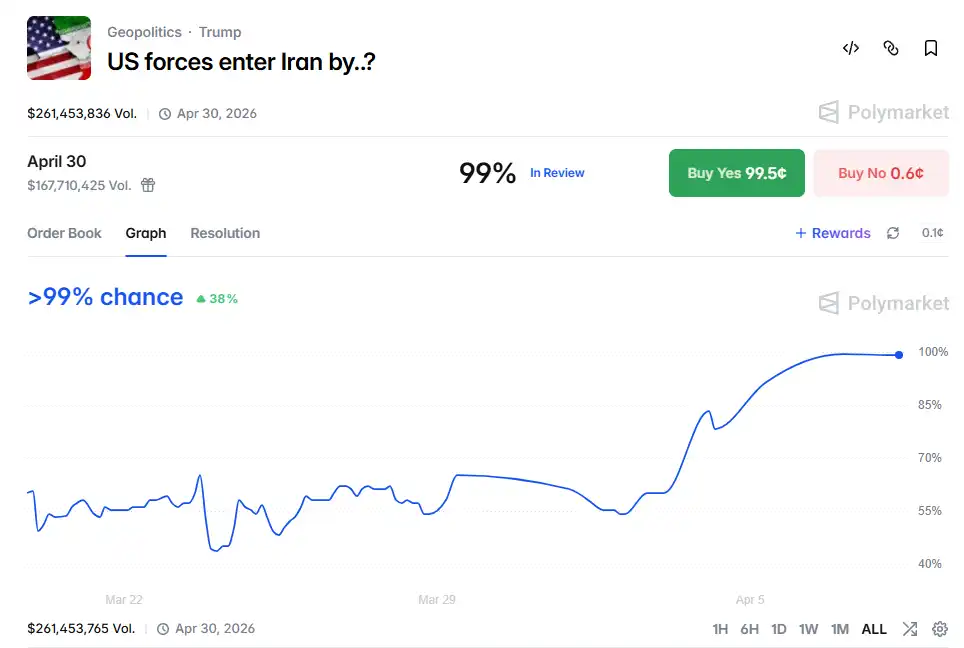
According to the settlement rules, active-duty U.S. military personnel (including special operations forces) entering Iranian land territory before a specified date would be considered an invasion, with the downed pilot not counting as an invasion, but U.S. special forces did indeed enter Iranian territory to rescue the pilot. Therefore, the special forces entering Iran to rescue the pilot met the standard for determining the U.S. invasion of Iran as Yes on Polymarket.
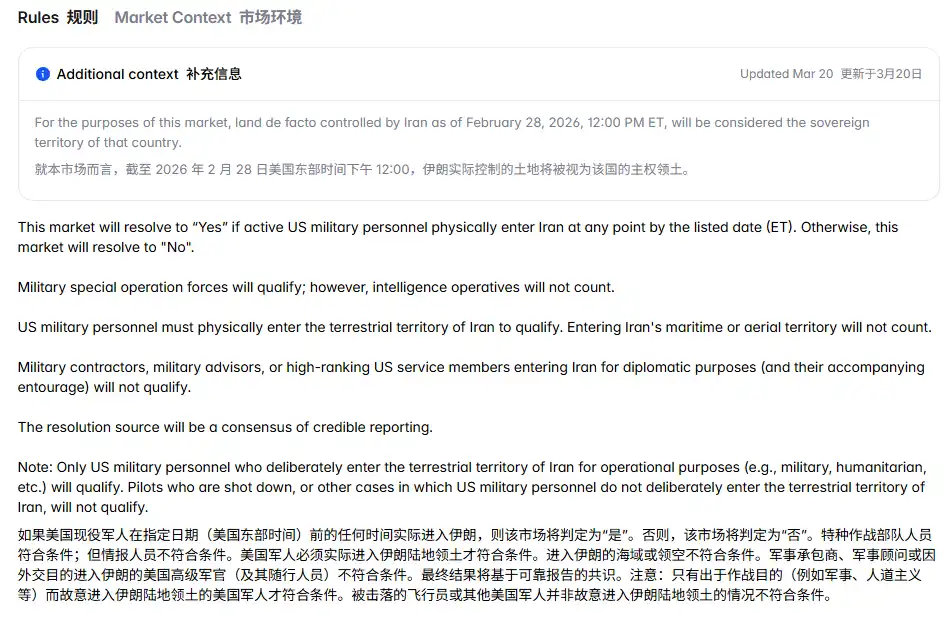
The "Pilot Rescue" event has been judged by Polymarket as the U.S. invasion of Iran, sparking strong community controversy.
Supporters of the "Count as Entry" (Yes side) believe that this action meets the definition of "entry" as per the rules. The U.S. Special Forces actively entered Iranian territory to carry out a mission, and the rules explicitly state that "special operation forces will qualify," including "for operational purposes (including humanitarian)." From an objective standpoint, this is the first confirmed U.S. ground penetration behavior in the current conflict context, with U.S. personnel indeed stepping on Iranian soil, hence should be considered an "entry."
Opponents of the "Count as Entry" (No side) argue that this definition is overly broad. They believe that this action was essentially a short-term, limited humanitarian rescue operation, not an invasion or occupation, and does not align with the general understanding of the public regarding "U.S. troops entering Iran."
Furthermore, the rules explicitly exclude that "pilots who are shot down... will not qualify," and this action revolves around the downed pilot, having the nature of "forced entry," which logically should fall into a similar exception category. Referring to past cases (such as similar regional actions not being considered invasions), rescue actions should not be equated with military entry; if judged as Yes, it may encourage marginal interpretations of the rules, weakening the seriousness and consistency of the market.
The Chinese community also generally believes that "entering Iran" should more specifically refer to large-scale ground or amphibious operations, rather than short-term actions of "rescue and leave."
Predict.fun: Polymarket Issuing Stablecoin Deemed as Token Launch
On the evening of April 6, Polymarket officially announced on X that it would undergo a comprehensive platform upgrade:
Rebuilding the trading engine, upgrading smart contracts; introducing a new native collateral token, Polymarket USD (1:1 pegged to USDC, to replace USDC.e, reducing bridging risks).
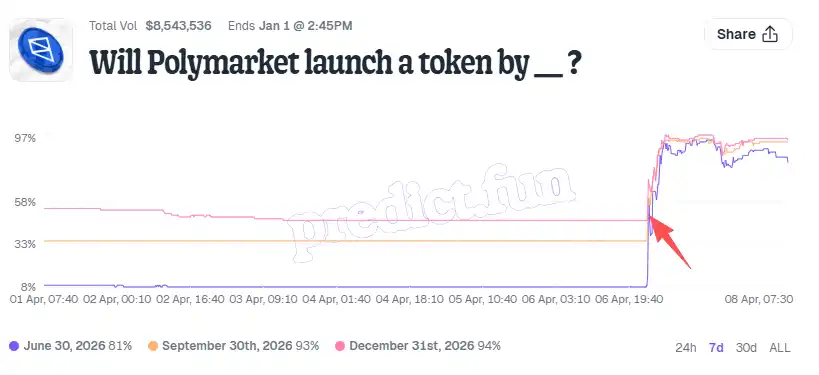
Notably, the second point mentioned the launch of the native collateral token Polymarket USD, directly impacting the probabilities of two related prediction events on Predict.fun.
One is token launch; the other is post-launch market cap:
1. When will Polymarket launch a token (Will Polymarket launch a token by ___ ?).
2. One day after opening, what was the FDV of Polymarket (Polymarket FDV above ___ one day after launch?)?
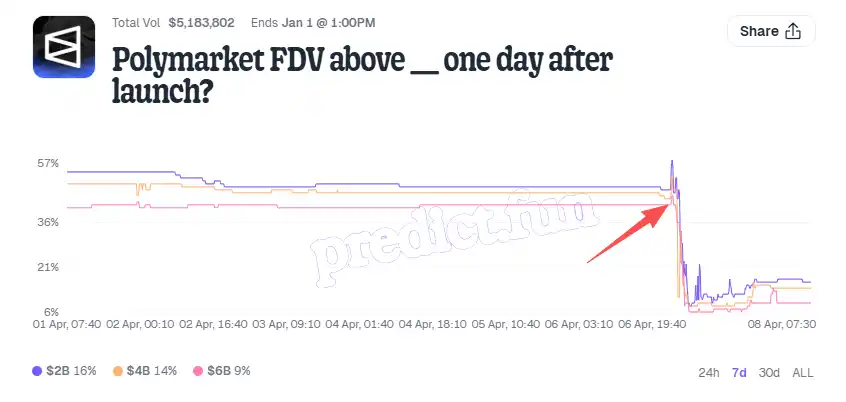
According to the settlement rules document, it is clearly stated that "any fungible token issued by Polymarket counts as 'issuance' for this event," and stablecoins are no exception. Therefore, Polymarket's stablecoin meets the criteria to be judged as Yes.
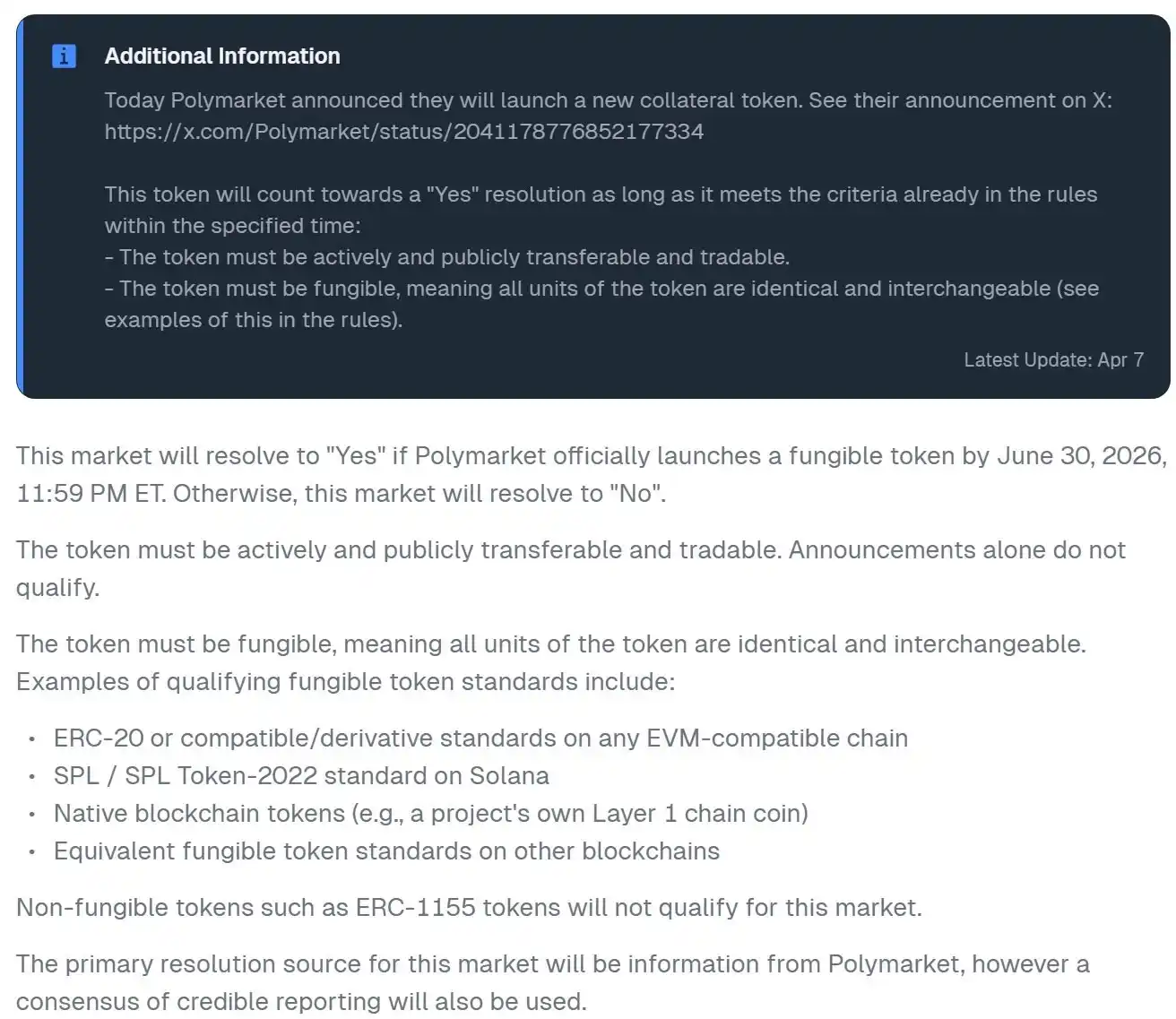
Settlement Rules Explanation
The community has engaged in a debate on this matter.
Supporters argue that based on the literal interpretation of the rules, "token issuance" is not limited to being a "governance token," but is a general reference to all tokens. Under this premise, Polymarket USD, as an ERC20/SPL fungible token issued by Polymarket, fundamentally meets the definition of "issuance." Furthermore, subsequent official clarifications are more of a reiteration of the original rules rather than a temporary rule change, making them somewhat reasonable in terms of compliance.
However, skeptics do not accept this explanation. On the one hand, they believe that including stablecoins in the category of "issuance" is an overinterpretation of the rules and a typical play on words. On the other hand, even if stablecoins are considered "issuance," the core of this prediction market is still the "Polymarket FDV," not the "Polymarket USD FDV." Stablecoins serve more as collateral or settlement tools, and their market value structure differs fundamentally from that of the project's native token (such as the POLY governance token), so they should not be directly equated or substituted for the overall project valuation logic.
Whose Side Are You On?
Overall, the controversial event in the prediction market actually revolves around a central question: are you betting on "reality" or on "rules"? Many times, these two do not completely overlap.
For those of us involved in prediction markets, understanding the rules themselves may be more important than predicting the outcome. How the information source is defined, whether there are any exceptions, whether there is room for interpretation—these details can directly determine the outcome at critical moments.
It is also for this reason that some high-probability events that appear to be a "financial management trap" may not be without risk, but may instead be a potential "loss trap." Many reversals occur precisely in these overlooked details. Instead of blind betting, take a closer look at the rules. It is more useful to do so than to complain after losing money.
-- Price
This content is provided for general informational purposes only and doesn't constitute financial, investment, legal, or tax advice. Any events, rewards, online promotions, or related information mentioned herein should not be considered a recommendation, solicitation, or invitation to purchase, sell, trade, or otherwise deal in any crypto assets. Crypto assets are highly volatile and may result in loss. The availability of WEEX services, products, and related events may vary by region. You are responsible for ensuring that your participation is in accordance with applicable local laws and regulations.
You may also like

Violations at Ukrainian Customs Increased by 20%

NVIDIA Seeks Chinese AI Base Station Suppliers to Develop 6G AI-RAN Base Stations

EU Extends Temporary Protection for Ukrainians Until 2028 with Restrictions

The White House has initiated a review of the rule-making process for the CFTC prediction market in the U.S

DeFi has reached its most dangerous moment: the real vulnerabilities are not in the code

South Korea's FIU meets with the five major exchanges to discuss new regulations for cryptocurrency transactions exceeding 10 million won
The U.S. SEC has revoked a settlement rule that has been in place for 50 years

"JUST 6th Anniversary x GasFree Super Carnival Month" is here: Enjoy "0" Gas transfer freedom and share a prize pool of 10,000 USDT

SBF withdraws the motion for a retrial, stating that it cannot obtain a fair hearing from the judge

NYSE submits a proposal to amend rules to allow the listing and trading of tokenized securities

The US SEC has accepted the NYSE's new regulations, proposing to introduce a tokenized securities trading mechanism to support on-chain settlement
The Bounce is a Illusion? The Bond Market Has Answered

The U.S. SEC cancels the "pattern day trader" rule and withdraws the minimum balance requirement
The Blockchain Association opposes Citadel's regulatory claims on DeFi and supports the SEC's innovation exemption framework
US Labor Department Proposes Opening 401(k) Plans to Crypto
Key Takeaways: The U.S. Department of Labor’s proposal aims to introduce cryptocurrencies into 401(k) retirement accounts through a…

Nasdaq will eliminate the 10% minimum public float requirement starting May 1 and introduce a "fast track" rule

Polymarket rules have changed, how should airdrop participants respond?

South Korea to Enhance Cryptocurrency Anti-Money Laundering Regulation, Covering Small Transactions of Less Than 1 Million KRW
Department of Commerce: China and the United States to Simultaneously Suspend Some Tariffs and Control Measures for One Year
The US SEC submitted rules for digital asset and fund disclosure to the White House, proposing to introduce an innovative exemption mechanism

The Paraguayan Anti-Drug Agency held a seminar to strengthen law enforcement against organizations that use cryptocurrency for crime

The U.S. SEC plans to amend broker-dealer rule 15c2-11 to exclude crypto assets from its scope

Sentient Reveals Tokenomics, How Will the Market Price It?

Thai Prime Minister Orders Tightening of Gold Trading and Digital Asset-Related Regulations
KindlyMD's Board of Directors has approved a Share Repurchase Plan

JusticiaNet: Establishing a Multi-Jurisdictional Legal Process for Criminal Cases Involving Virtual Currency, Exploring Three Disposal Measures: "Liquidation, Destruction, Return"
How is a WeChat Account Stolen and How to Prevent It?
HKEX Halts Trading as Cryptocurrency-Related Stock Primas Falls 70%

The U.S. Accounting Standards Board is considering adding the "Cryptocurrency Transfer" accounting project

China and the United States Begin Implementation of Kuala Lumpur Economic and Trade Consultations Consensus
Violations at Ukrainian Customs Increased by 20%
NVIDIA Seeks Chinese AI Base Station Suppliers to Develop 6G AI-RAN Base Stations
EU Extends Temporary Protection for Ukrainians Until 2028 with Restrictions
The White House has initiated a review of the rule-making process for the CFTC prediction market in the U.S
DeFi has reached its most dangerous moment: the real vulnerabilities are not in the code
South Korea's FIU meets with the five major exchanges to discuss new regulations for cryptocurrency transactions exceeding 10 million won

Contents
Latest articles


Latest coin listings on WEEX


