
Hunter Biden's Laptop Token Lost 98% of Its Value in Under an Hour: Here's What Happened

 Prefer us on Google


Most meme coins that launch and crash follow a familiar rhythm: a spike, a bleed, a slow fade into irrelevance over days or weeks.
Hunter Biden's Laptop didn't do that. It compressed the entire cycle into under an hour, and the chart afterward looks less like a typical token launch and more like a controlled demolition. What Hunter Biden's Laptop actually did in its first sixty minutes is worth walking through in detail, along with a genuine attempt at explaining why, rather than just repeating the numbers behind Hunter Biden's Laptop's launch.
The Numbers, Laid Out Plainly
LAPTOP opened trading on Base on September 9. According to CoinGecko's chart, the token hit $199.51 at 14:05 GMT+2, with $5.29 million in volume recorded at that specific moment. CoinDesk separately clocked the peak even earlier, at $190.81, within two minutes of trading opening. Either way, the shape is the same: this thing went nearly vertical in the first minutes of its existence.
Then it fell off a cliff. CoinDesk reported the price at $3.70 within the first hour, a roughly 98% drop from the intraday high. By the 24 hour mark, CoinGecko's data shows the token sitting at $0.7804, down 97.1% over the day, with the price having ranged as low as $0.7234. Market cap, which had briefly been estimated in the billions during the opening chaos, settled at $274.68 million, against a fully diluted valuation of $784.81 million on the token's full 1 billion supply.
What actually stands out isn't just the size of the crash. It's how quickly the chart flattened out afterward. Once the price fell below roughly $1, it stopped moving in any dramatic way and has essentially gone sideways since. That's a very specific shape, and it says something about what kind of event this actually was.
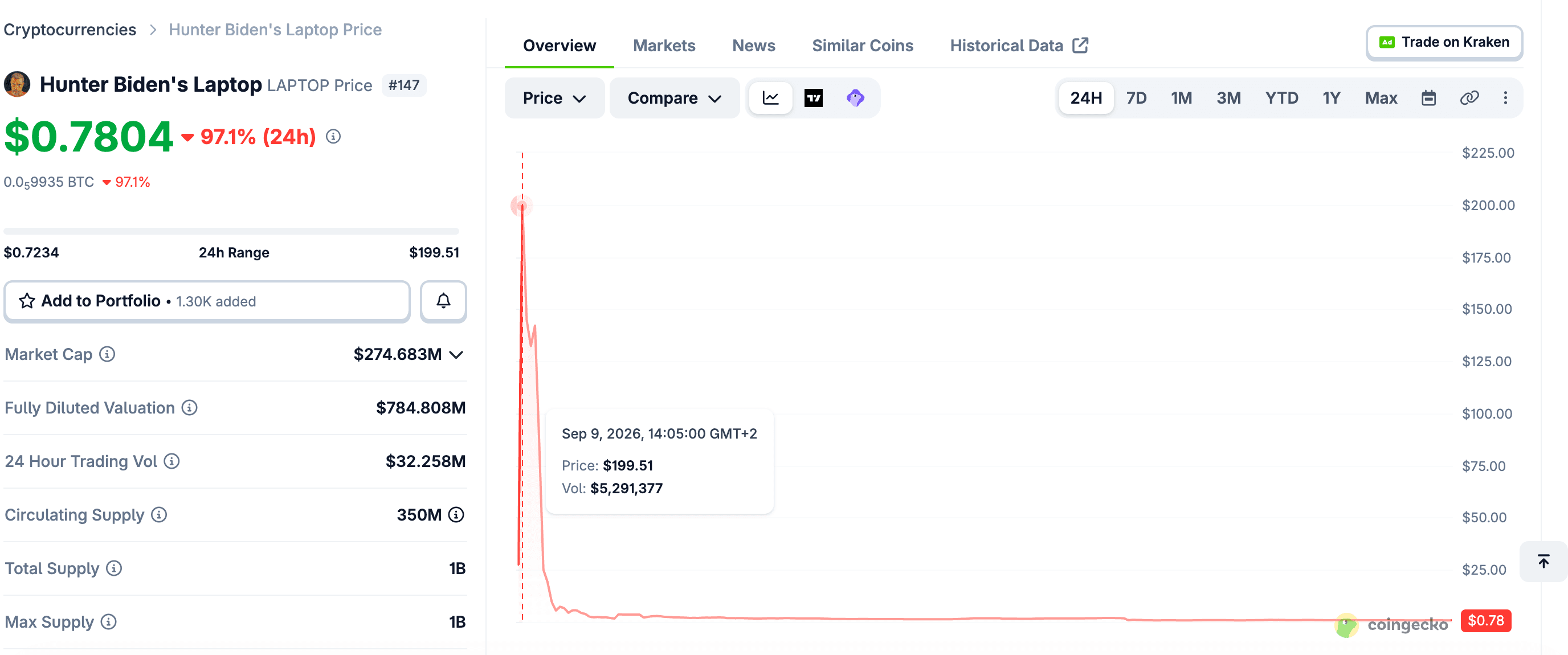
Source: CoinGecko. Data captured on September 10, 2026.
Why This Doesn't Look Like a Normal Meme Coin Pump and Dump
Most coverage of this launch treats it as a garden variety meme coin flame out, but that framing undersells what the data actually shows. A normal pump and dump involves real buyers piling in, some genuine belief, however misguided, that the price will keep climbing, and then a gradual unwind as that belief fades. This chart doesn't look like that. It looks like a liquidity problem colliding with enormous demand for about ninety seconds.
The detail that makes this clearest: at the peak, blockchain analytics firm Arkham reported that the token's fully diluted valuation briefly touched $144 billion, while the actual liquidity pool backing that price sat at just $48,000. Forty eight thousand dollars of real liquidity was generating a headline valuation in the hundred-billion range. That's not a market pricing in genuine belief about a project's future. That's a price discovery mechanism getting completely overwhelmed by the first wave of buyers, because there was almost nothing on the other side of the trade to absorb them.
When a market has that little depth, price isn't really "discovering" anything. It's reacting to whoever happens to be buying in that exact second, with no meaningful resistance until enough sellers show up to push back. Given how much attention this launch generated, and how little actual liquidity existed to meet it, a spike this extreme wasn't a surprising outcome. It was close to an inevitable one.
The Detail Worth Scrutinizing Most: What Happened Before Launch
This is the part of the story that deserves the closest look. According to BaseScan data cited by CoinDesk, a multisig wallet tagged by Arkham as belonging to the Laptop Token project received 100 million tokens, a full 10% of total supply, seven days before trading even opened. By the time the chaos was unfolding, that wallet had already distributed roughly 42.5 million of those tokens, including 15.5 million to market maker GSR and 14.5 million to an address nobody has identified.
Speculating about intent here isn't useful, since what that unidentified address actually represents isn't publicly known. But the structural point stands regardless of intent: when insiders move a meaningful chunk of total supply in the week before a token opens to the public, and the public has no visibility into who's receiving it or why, that condition makes a launch like this more likely, not less. It doesn't require bad intent to produce a bad outcome. It just requires supply to be positioned in a way that outside buyers can't see or price in.
-- Price
Why the Trading Volume Data Supports This Read
In the first hour, roughly $19 million in volume moved across 314 different trading pairs, according to CoinDesk's reporting, with nearly half of that concentrated in a single Aerodrome Slipstream USDC pool and most of the rest running through Uniswap v4 on Base. That fragmentation across 314 pairs, in the first sixty minutes, tells its own story. This wasn't one deep, orderly market. It was dozens of thin pools, all getting hit with buy pressure simultaneously, each one capable of producing wildly different prices depending on exactly how much liquidity happened to be sitting in it at that moment.
That's the mechanical explanation for how a token can hit $199 and $0.78 within the same day without anything about the underlying project actually changing. The project didn't get 97% worse in 24 hours. The market simply had no way to hold a coherent price under that kind of pressure with that little liquidity behind it.
Why This Matters Beyond This One Token
Stepping back from this specific launch, what the first hour of Hunter Biden's Laptop actually demonstrates is a pattern that shows up whenever a high profile, attention grabbing launch collides with genuinely thin liquidity: the headline numbers, the billion dollar valuations, the eye popping percentage moves, often say almost nothing about the project itself. They say something about the gap between attention and liquidity in that specific moment. A $144 billion valuation sitting on $48,000 of real liquidity isn't a verdict on the underlying meme, or on the token's long-term prospects, or on anything at all except how thin the order book was when the buying started.
The lesson worth taking seriously is that the size of a number on launch day says almost nothing about durability. What actually matters is how much real liquidity sits underneath the price, and whether that liquidity was distributed transparently before trading opened or concentrated in the hands of a small number of wallets nobody outside the project could see coming.
Conclusion
Hunter Biden's Laptop token went from $199.51 to under $4 in under an hour, then kept sliding to $0.78 within 24 hours, a roughly 97% to 98% decline depending on which snapshot is used. The mechanical cause is straightforward once examined closely: a $48,000 liquidity pool briefly supporting a $144 billion valuation was never going to hold, and a 10% supply allocation moved to insider wallets in the week before launch didn't help. Whatever anyone believes about the token's premise, the chart itself is really a story about how little liquidity it takes to produce a headline-grabbing number when enough attention arrives at once.
FAQ
1. How high did the token's price actually reach?
It hit an intraday high of $199.51 at 14:05 GMT+2 on September 9, according to CoinGecko, with CoinDesk separately clocking a peak of $190.81 within the first two minutes of trading.
2. How much did the price fall from its peak?
The token fell to roughly $3.70 within the first hour, a decline of about 98%, and was trading around $0.78 24 hours after launch, down 97.1% for the day according to CoinGecko.
3. Why did the valuation briefly reach $144 billion?
Blockchain analytics firm Arkham reported the token's fully diluted valuation briefly touched $144 billion while the liquidity pool backing that price held just $48,000, meaning a small amount of buying pressure produced an extreme headline valuation.
4. Did insiders move tokens before the public launch?
Yes. A multisig wallet linked to the project received 100 million tokens, 10% of total supply, seven days before launch and had distributed roughly 42.5 million of them by the time trading opened, according to BaseScan data.
5. What is the token's market cap now?
As of 24 hours after launch, market cap stood at $274.68 million, with a fully diluted valuation of $784.81 million based on the token's full 1 billion supply.
This content is provided for general informational purposes only and doesn't constitute financial, investment, legal, or tax advice. Any events, rewards, online promotions, or related information mentioned herein should not be considered a recommendation, solicitation, or invitation to purchase, sell, trade, or otherwise deal in any crypto assets. Crypto assets are highly volatile and may result in loss. The availability of WEEX services, products, and related events may vary by region. You are responsible for ensuring that your participation is in accordance with applicable local laws and regulations.
You may also like

Bonk Guy Optimistic About USELESS Becoming the Meme Coin King

Combination of Synthetic Stocks and Meme Coins Raises Concerns Over Complex Risks

Hunter Biden: No Internal Sell-Off Amid LAPTOP Meme Coin Crash
Comparison of Four US Stock Tokens: BNB Chain, Robinhood Chain, Base, Solana

TradingView Analysts Issue Sell Signal for Shiba Inu

Is MemeToro a scam? Key accusations about the project and $MT presale examined
FOMO Daily Activity Soars: Is Trading Memes Becoming Like Scrolling Through Short Videos?
Canal Market Cap Surpasses $3.39 Million, Establishes Eight Stock Token Ports

Laptop Coin vs TRUMP Meme Coin Price: What Two Crashes Say About Political Meme Coins
Laptop coin crashed 98% in under an hour, while TRUMP took nineteen months to fall the same distance, the real link between them is the buyers, not the timeline.
Bitcoin Spot ETF Sees Net Outflow of $120 Million, Ethereum Spot ETF Records Net Inflow of $34.75 Million

BNC4 Completes First Daily Buyback, Repurchasing and Destroying 10,169,329 4Stock Worth Approximately $356,000

What is dogwifhat (WIF)? An Explanation of Wallet Numbers and Holder Statistics

Robinhood Chain Market Cools Down, Market Awaits Arc Chain Launch
LaserCat Remains Optimistic About the Meme Coin Market

Declining Trading Volume Will Weaken Incentives for Holding Crypto Stocks
LAPTOP Deploys 4 Million Tokens to Incentivize Liquidity, 10 Million Tokens to Be Burned

Zora's New CEO Advances Token Buyback and Holder Reward Mechanism

CLARITY Act: Ripple CLO urges Senate to hear crypto holders

200 Million Penguins Burned, Valued at $160,000
Laptop Market Maker Volume at 23 Million, GSR Markets, G20, Wintermute Holdings

Bonk Guy Turns Bullish on Solana, Supports On-Chain Community

15 Practical Protocols to Watch on Robinhood Chain

Phishing Websites and Imitation Risks Ahead of LAPTOP Airdrop
Causes of Investment Losses in Meme Coins: The Difference Between Unrealized and Realized Gains
Apple Foldable Event Nears | WEEX TradFi Daily(September 9, 2026)
Global markets are focused on Apple’s fall product event, firmer energy prices, and the renewed valuation pressure on risk assets. Apple shares retreated ahead of the launch as investors weighed foldable-device pricing, on-device AI monetization, and potential sell-the-news volatility. Energy equities benefited from supply-risk repricing, which also reinforced sticky-inflation concerns and a higher-for-longer rates narrative. In crypto, bitcoin eased toward the mid-$78,000 range; although spot ETF inflows remain supportive, positioning has turned more defensive in the face of rising hike expectations. After the close, AeroVironment earnings and Apple’s product details could shape the next move across tech and thematic trades.

WEEX Exclusive:Apple Foldable Event Nears | WEEX TradFi Daily(September 9, 2026)

What Are Other Chains Doing Amidst the Hype of Robinhood?

$LAPTOP Price Prediction 2026: Can Hunter Biden's Coin Hit $0.01?

Is Hunter Biden $LAPTOP Coin a Pump, Risk, or Meme Coin Trap?
4Stock Minting Deposit Address Receives Over $8.9 Million USDC
Bonk Guy Optimistic About USELESS Becoming the Meme Coin King
Combination of Synthetic Stocks and Meme Coins Raises Concerns Over Complex Risks
Hunter Biden: No Internal Sell-Off Amid LAPTOP Meme Coin Crash
Comparison of Four US Stock Tokens: BNB Chain, Robinhood Chain, Base, Solana
TradingView Analysts Issue Sell Signal for Shiba Inu
Is MemeToro a scam? Key accusations about the project and $MT presale examined


