
Google, Circle, Stripe Flock Together to Let AI Spend Money: Payment Giants' Joys and Worries in 2026 Q1

 Prefer us on Google


Author | Kaori
Editor | Sleepy.md
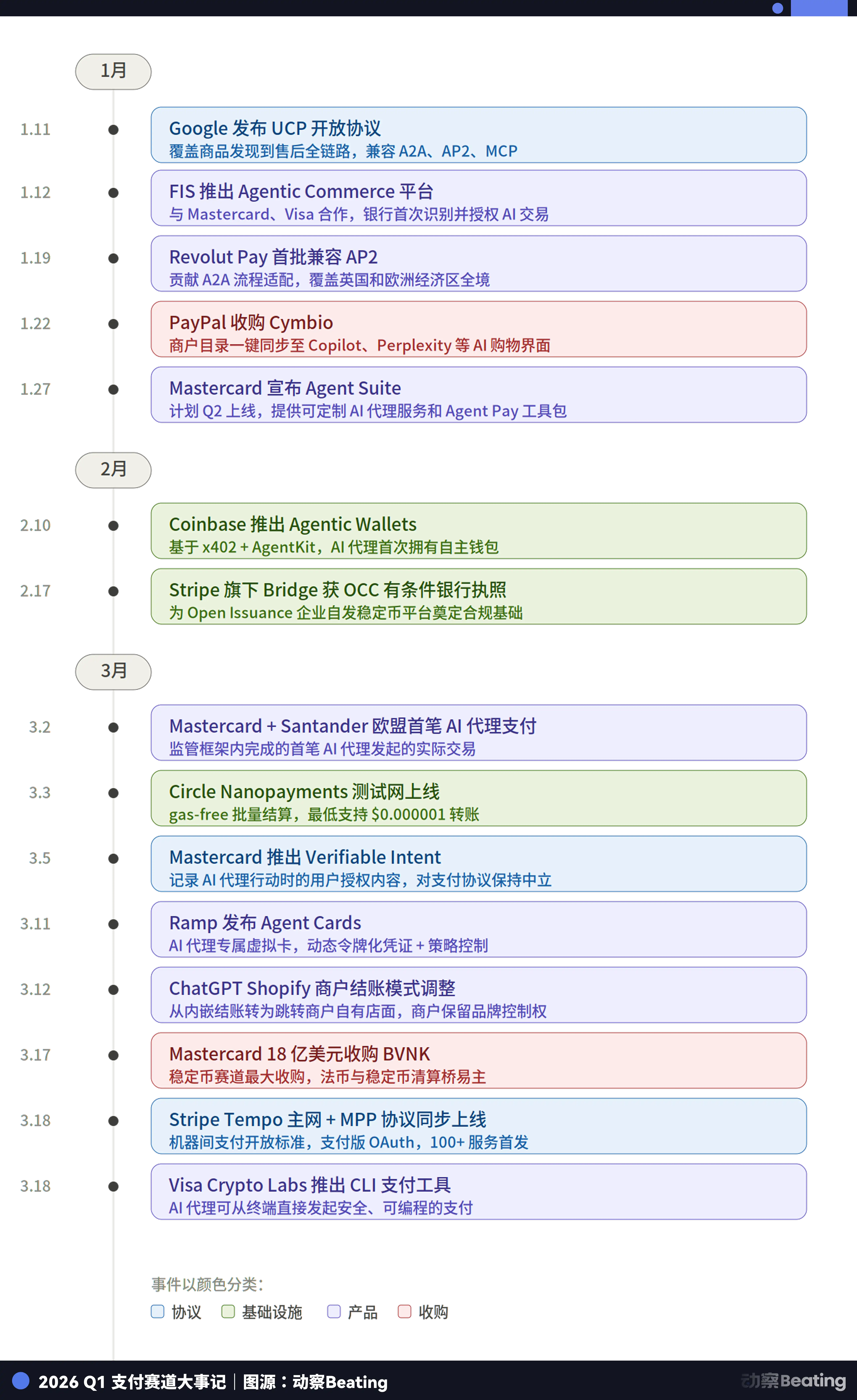
In the first three months of 2026, players in the payment space had a fulfilling time.
On January 11, Google unveiled the Universal Commerce Protocol (UCP) at the National Retail Federation Conference in the U.S., attempting to define a common language for AI Agent commerce. In the same week, Revolut announced being among the first EU payment methods compatible with Google AP2, PayPal revealed the acquisition of the merchant directory sync company Cymbio, and Mastercard launched the Agent Suite.
In February, Coinbase officially introduced Agentic Wallets, enabling AI Agents to have their own wallets for autonomous spending, earning, and trading of crypto assets. The x402 protocol deeply integrated with the Google ecosystem has already processed over 50 million transactions.
March saw a flurry of activity. Circle released Nanopayments, Ramp launched Agent Cards, Mastercard publicly announced the acquisition of stablecoin infrastructure firm BVNK for up to $1.8 billion, and the mainnet of Tempo, nurtured by Stripe and Paradigm, went live alongside the unveiling of the Machine Payments Protocol (MPP).
Within these three months, a dozen significant moves took place, with a mix of joy and concern. These events may seem disparate, but they all point to the same structural shift: when the cost of machine-to-machine transactions approaches zero, the true enemy of payment giants is no longer each other but zero-cost itself.
Key Events Recap
In the Zero-Cost Era, No One Dominates
Just six months ago, we were debating who would legislate for AI Agents. Stripe's ACP, Google's AP2, Mastercard's Agent Pay—these three paths pursued their own agendas, vying for the authority to define the same proposition.
Now, this war has essentially ended, not because one side won, but because everyone realized that there will be no single winner.
Google's recent introduction of UCP integrates all mainstream standards, responsible for searches and commercial transactions within the Gemini ecosystem. Stripe's MPP, launched with Tempo, also supports Mastercard and Visa system integration, facilitating autonomous machine-to-machine payments. Mastercard's Agent Pay handles auditable authorization for high-value transactions.
It used to be a turf war, now it's a turf delineation. The provisional nature of the protocol layer landscape means that the decisive competition has moved elsewhere.
Let's look at a set of data released by Enterprise Onchain. Over the past 9 months, the AI Agent has completed 140 million transactions, totaling $43 million, with 98.6% using USDC. The average amount per transaction is $0.31, and the AI Agent with purchasing power has surpassed 400,000.
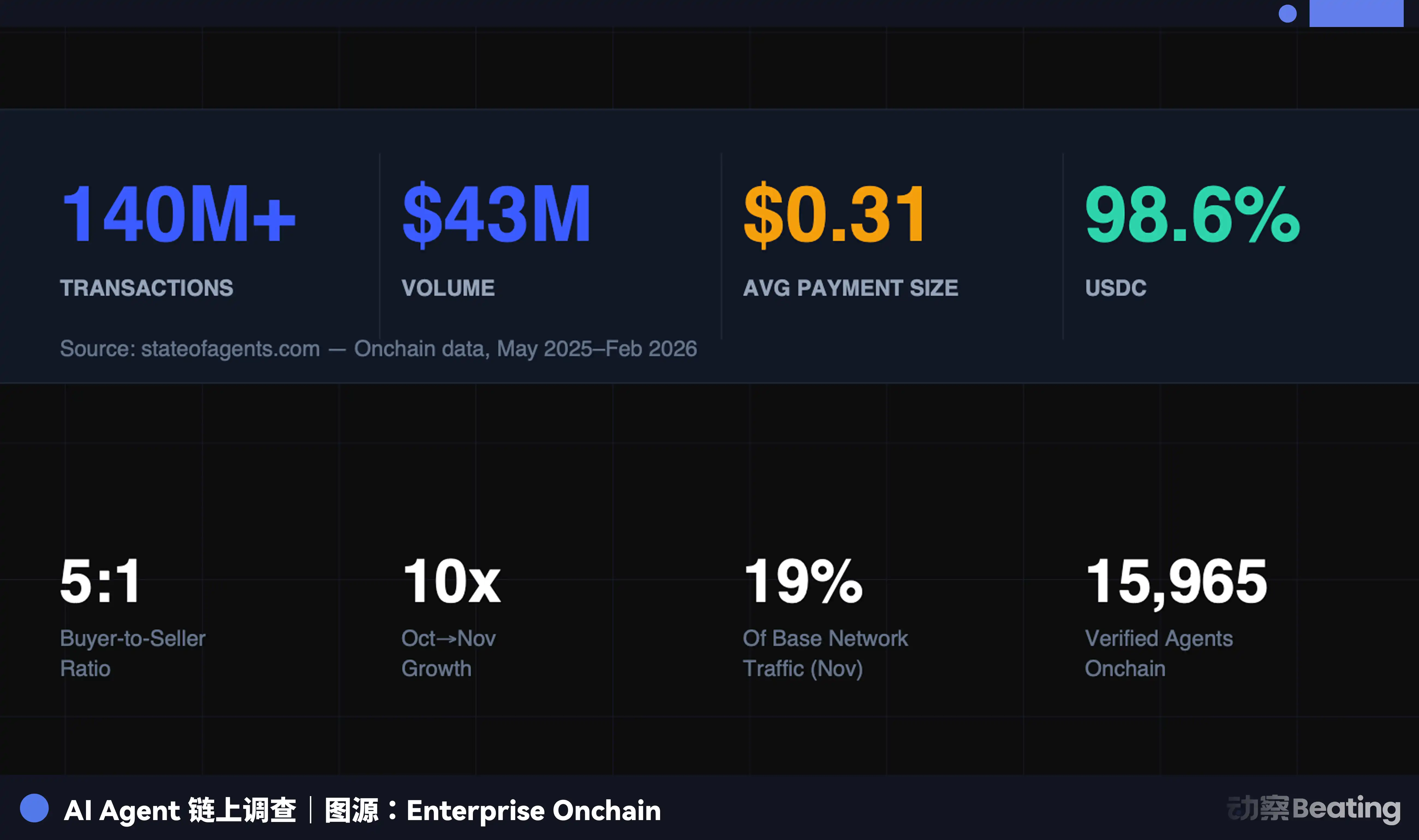
Let's unpack the significance of these numbers.
First, machine-autonomous transactions. 140 million transactions with no human intervention, bank approval, or credit card verification. Code to code, protocol to protocol, processes that once required human signatures, reconciliation, and settlement are now autonomously executed by machines.
Second, extremely small transaction amounts. With an average transaction amount of $0.31, most of these payments are microtransactions in scenarios such as API calls, computational resource purchases, and data access. Under the traditional payment system, such transactions would never occur as the minimum transaction fee on any card network would exceed the transaction's value.
Third, approaching zero cost. In conjunction with the x402 protocol, payments are directly embedded in HTTP requests. Circle Nanopayments aggregate tens of thousands of small payments off-chain and periodically batch settle on-chain, reducing developers' single transaction gas fees to zero and shifting the on-chain settlement costs to Circle in the batch settlement layer.
Transactions between machines, no checkout pages, no payment gateways, no intermediaries — this is the source of anxiety.
Of course, zero cost currently only applies to the specific scenario of machine-to-machine microtransactions. Stablecoins are not truly free; on the Ethereum mainnet, the gas fee for a small stablecoin transaction may exceed 20% of the transaction value, which is why Stripe created Tempo to address this issue.
On the consumer payment front, card networks still hold an advantage that stablecoins cannot replicate: unified consumer protection, consistent user experience, and the card's abstract layer with flexible routing capabilities at the underlying level.
However, this does not change the essence of anxiety. In the high-frequency machine-to-machine microtransaction scenario, zero cost is already a reality, and this gap is rapidly widening. Deloitte predicts that the global Agent market will reach $45 billion by 2030. This is a whole new transaction world, tearing open a massive gap on the fringes of traditional payments.
Responses from Giants: From Toll Collecting to Bridge Building
Faced with the threat of zero-cost, traditional payment giants have adopted different response strategies, but they share a common underlying logic: if they cannot charge fees in machine-to-machine micropayment scenarios, then they will control the bridge between old and new systems to collect fees there.
Visa's strategy is one of absorption rather than confrontation. USDC settlement has officially launched in the U.S., with crypto-friendly banks such as Cross River Bank and Lead Bank starting to use it. Visa Direct supports stablecoin preloading and direct payments.
In other words, you can use stablecoins, but please use my pipeline. Visa has also participated in the development of MPP, extending the protocol to card payment scenarios, which is a typical move of joining if you can't beat them.
Mastercard spent $1.8 billion to acquire BVNK, acquiring the bridge between fiat and stablecoins. BVNK supports fiat-stablecoin conversions on all major blockchain networks in over 130 countries, which is crucial infrastructure for the AI Agent payment era.
Mastercard's Chief Product Officer Jorn Lambert's response to the threat of stablecoins to card business was very direct: there is no issue with the card business, and the acquisition is to expand into new areas such as remittances. However, the deeper logic is that as stablecoin transaction volumes rapidly increase, controlling the clearing bridge between fiat and stablecoins means controlling the chokepoint of value flow.
Stripe has the greatest ambition. It has its own blockchain Tempo, its own MPP protocol, and a platform called Open Issuance that allows businesses to issue their own stablecoins and share reserve income, which is the epitome of vertical integration.
The combination of Tempo + MPP + Open Issuance means that Stripe is no longer just a payment processor; it is becoming an infrastructure operator for the AI Agent payment era.

PayPal took a different path. The acquisition of Cymbio was not to control the payment pipeline but to control the distribution of merchant catalogs. Cymbio's core capability is Store Sync technology, which allows a merchant's product catalog to be synchronized across multiple AI shopping surfaces with a single click, meaning that small and medium-sized merchants no longer need to adapt to each AI platform separately.
When AI agents replace humans in discovering products, whether a merchant's product catalog can be seen by AI becomes a matter of life and death. PayPal is betting that in the Agent Commerce era, being discovered by an agent is in itself valuable.
An interesting intermediate state is Ramp Agent Cards, which provides a virtual card to an AI Agent that still follows the Visa card network rails, but each transaction is dynamically authorized without exposing actual card information, essentially transforming corporate expense cards into Agent wallets.
Whether this is a continuation of traditional payments or a stopgap measure during a transition period remains unclear. If the dominant form of machine-to-machine transactions ultimately moves towards the stablecoin-native path, then Agent Cards may represent the last opportunity for the traditional card networks to be relevant in the new era.
-- Price
The New Era: How to Make Money?
One question has remained unanswered. In the zero-cost track, transactions themselves do not generate fees. So, who makes money?
Circle's Nanopayments rely on infrastructure service fees, Stripe's Open Issuance relies on reserve fund earnings, and Mastercard, after acquiring BVNK, profits from the conversion service between fiat and stablecoins.
All three fee models share a common characteristic: shifting the fee point from the transaction itself to the conditions under which the transaction takes place. Essentially, this is closer to infrastructure rent rather than a transaction tax.
This marks a fundamental shift in business models. Over the past fifty years, the moat of payment networks has been network effects. The more merchants, the more willing consumers are to use it; the more consumers, the more merchants need to onboard, and this flywheel profits from the commission rights brought by scale.
In the world of machine-to-machine transactions, this flywheel has failed. Machines only need a stable, programmable, low-cost settlement layer, and whoever can provide this becomes the new infrastructure provider.
The survival of payment giants is not a big issue. What remains truly unresolved is where the power shifts to in an industry that has relied on commission to maintain control, once commission loses its relevance.
This content is provided for general informational purposes only and doesn't constitute financial, investment, legal, or tax advice. Any events, rewards, online promotions, or related information mentioned herein should not be considered a recommendation, solicitation, or invitation to purchase, sell, trade, or otherwise deal in any crypto assets. Crypto assets are highly volatile and may result in loss. The availability of WEEX services, products, and related events may vary by region. You are responsible for ensuring that your participation is in accordance with applicable local laws and regulations.
You may also like

Ethereum Layer 2 project Zero Network announces closure, multiple protocols cease operations consecutively

Coinbase is being sued for freezing funds related to the theft of 55 million dollars in DAI
Robin Markets completed a $475,000 angel round of financing, led by Fabric VC
Illustration of Zero Hash's 28 Web3 business partners: Connecting cryptocurrency and fiat currency settlement with compliant licenses

Cook Passes the Baton, Anthropic Gears Up | Rewire News Morning Brief

WEEX Launches Contract Mining Event: Up to 30% Fee Rebate + $2 Million WXT Repurchase

Afraid to Open the Pandora's Box? Anthropic's Most Powerful Model Ever Dares Not Be Disclosed

Former OpenAI employees establish a $100 million VC fund Zero Shot, focusing on AI investment direction

The TVL of the "100ETH" size pool on Tornado Cash decreased by 40% in the past week, with over 120,000 ETH being moved.

BC.GAME Community Open Letter: Launch of the 'Zero Edge Plan', Distribution of 1 Billion Platform Tokens, Game House Edge set at 100% Rebate

Hotcoin Launches MAGMA Trading with Zero Fees Initiative
Key Takeaways Hotcoin to list MAGMA on December 16, strengthening its portfolio with trending assets. New listing on…
How to Use a Trading Bot to Earn Profits on Polymarket?

0G collaborates with Nanyang Technological University, Singapore to jointly launch a $5 million decentralized AI research initiative

Boundless ZKC Token Price Dives 46% After Binance Debut Amid Airdrop Sell-Off – Latest Insights as of September 16, 2025
Imagine stepping into a bustling digital marketplace where a shiny new token bursts onto the scene, only to…
RFG Surges Over 70% in 24 Hours, Breaks $0.0019 to Hit New All-Time High
Ant Group Launches the DT Tokenization Suite to Build a One-Stop Tokenization Solution

WEEX Official Product Launch: Win LALIGA Tickets & Unlock the 3-in-1 Crypto Trading Suite
Trade crypto without downloading an app. Join the WEEX H5, API, SKILLs livestream to explore the new trading experience, win LALIGA VIP tickets, and share 420 USDT rewards.
Jane Street Records Record Increase in iShares Silver ETF Holdings in Q4, Becoming the Largest Holder

LALIGA Preview: Barcelona Eyes Continued Dominance While "The Lightning" Targets a Camp Nou Upset
[Match Info]
- Fixture: FC Barcelona vs. Rayo Vallecano
- Kick-off: March 22, 04:00 AM (Beijing Time)
- Venue: Estadi Olímpic Lluís Companys
Aster Chain officially launches: defining a new era of on-chain privacy and transparency
BitRing will launch the AI short drama "BitRing-Satoshi Nakamoto Block Zero."
March 6 Key Market Update You Can't Miss! | Alpha Morning Report

Zero-Fee Gold Futures and $100K Rewards: Why Traders Are Turning to WEEX for Tokenized Gold
Explore WEEX's $100,000+ gold campaign featuring, zero-fee gold contracts, and $30,000 PAXG rewards. Trade tokenized gold today.
Crypto’s Next Battle: Privacy Faces a Chicken-Egg Dilemma with Regulators
Key Takeaways The integration of cryptocurrencies into bank systems is fueling a privacy versus transparency conflict. Privacy-preserving tech…
CZ: When young, it is important to balance spending, saving, and investing, finding the optimal balance point
Crypto’s Next Challenge: Privacy and the Chicken-Egg Dilemma
Key Takeaways Privacy is becoming a central issue as cryptocurrencies move into traditional banking and state-backed systems. Regulatory…

Zerion-incubated L2 network Zero Network has relaunched and fully resumed operations

First Zero, First Revival: A Real Story from the WEEX Global AI Trading Hackathon Preliminary Round
WEEX Labs, the innovation arm of the global crypto exchange WEEX, launched the preliminary round of its flagship AI trading hackathon, AI Wars: WEEX Alpha Awakens, on January 12, 2026. Backed by world-class sponsors including AWS, the prize pool has reached $1.88 million, with a Bentley Bentayga S awaiting the champion in Dubai. Already, 788 elite teams worldwide are battling for a spot in the finals. This is more than a hackathon — it is a real-market stress test for AI trading. Registration remains open until January 18. If you want your AI to face real volatility, this is your moment.

EF Board Member: Ethereum's Future Depends on the Direct Integration of Zero-Knowledge Proofs

SafePal Launches 2026 New Year Limited Edition Mastercard Design
Ethereum Layer 2 project Zero Network announces closure, multiple protocols cease operations consecutively
Coinbase is being sued for freezing funds related to the theft of 55 million dollars in DAI
Robin Markets completed a $475,000 angel round of financing, led by Fabric VC
Illustration of Zero Hash's 28 Web3 business partners: Connecting cryptocurrency and fiat currency settlement with compliant licenses
Cook Passes the Baton, Anthropic Gears Up | Rewire News Morning Brief
WEEX Launches Contract Mining Event: Up to 30% Fee Rebate + $2 Million WXT Repurchase