
Foreign Media: Three AI Pioneers Oppose Comprehensive Tightening of Open Models

 Prefer us on Google


As the debate over AI safety intensifies, foreign media reports that Geoffrey Hinton, Fei-Fei Li, and Andrew Ng recently discussed the issue of open models at the Ai4 conference in Las Vegas. While their positions are not entirely aligned, all three oppose the dominance of a few large tech companies in the pace of AI development.
Opposing a Few Companies Controlling Access
The article states that the three researchers share a common concern: if AI is controlled by a few companies, the space for innovation may be compressed. Ng explicitly stated that he does not want to see "gatekeepers" in the AI field, as this would limit how developers, businesses, and the public can access AI.
He believes that large companies will naturally protect their own advantages, which could influence the formation of industry rules. The result may be that only the companies with the most funding and computing power can continue to build the most advanced systems. Ng suggests maintaining a coexistence of multiple model providers, allowing models and companies to compete in the market rather than letting a few platforms dominate.
Hinton Distinguishes Open Source Code from Open Weights
However, Hinton does not equate "open source software" with "open weight models." According to him, open source software makes the code public, allowing external parties to check for vulnerabilities and propose modifications; open weights, on the other hand, directly hand over the parameters of a completed large model to the outside world, significantly lowering the barrier for secondary development.
He stated that he previously opposed open weights because it would allow some individuals to repurpose foundational models into tools for cyber attacks at a lower cost. However, he also acknowledges that this debate has become difficult to reverse in reality. With the continuous emergence of open weight models, the barriers that training costs once constituted have been significantly weakened.
Nevertheless, Hinton does not advocate for halting AI development. The article notes that he still believes AI will enhance productivity and improve fields such as education and healthcare, but we cannot ignore the potential risks. He also mentioned that it is unfair to label all those who express concerns about AI risks as "panic creators."
Li Fei-Fei Advocates for Layered Openness
In contrast to Ng's emphasis on open competition and Hinton's focus on safety risks, Li Fei-Fei opposes simplifying the discussion into two choices: "completely open" or "completely closed." She believes that complex software and research systems inherently exist at different levels, and different stages can adopt varying degrees of openness.
Using nuclear physics as an example, she stated that academic papers can be publicly published, but uranium materials are strictly regulated, and experimental phases fall somewhere in between. Based on this, she argues that AI can adopt a similar approach: maintaining a certain level of openness in research discoveries, education, and international cooperation while allowing companies to retain closed-source systems and business models.
The article also mentions that Li Fei-Fei cites the Human Genome Project to illustrate that foundational knowledge platforms formed through collaboration between public institutions and the private sector can simultaneously support research advancement, corporate profit, and social application. She believes that AI infrastructure should also develop in this direction rather than getting caught up in an either-or debate.
All Three Recognize the Need for Regulation
Although the three have different judgments about the boundaries of open models, their attitudes toward regulation are similar. The article states that they all believe AI still requires a certain degree of regulatory constraints to develop in a direction more beneficial to society.
Hinton stated that the development of AI should not be left entirely to entrepreneurs to decide. The current debate surrounding open models is no longer just a technical route dispute; it also relates to the distribution of industry power, international competition, and the direction of AI safety governance.
-- Price
This content is provided for general informational purposes only and doesn't constitute financial, investment, legal, or tax advice. Any events, rewards, online promotions, or related information mentioned herein should not be considered a recommendation, solicitation, or invitation to purchase, sell, trade, or otherwise deal in any crypto assets. Crypto assets are highly volatile and may result in loss. The availability of WEEX services, products, and related events may vary by region. You are responsible for ensuring that your participation is in accordance with applicable local laws and regulations.
You may also like

The Twilight of Native Crypto

Nikita Bier Charges $500 Per Minute for Consulting Services

Andrew Kang's Shareholder Letter: Robotics Investment Reaches a Turning Point, Private Valuations Still Severely Lagging

Bitcoin Spot Demand: The Signal That Hadn't Reappeared Since the October 2025 Record

Vietcombank Warns of AI-Driven Fraud

$1 Billion in 48 Hours: X Prepares Crypto Trading Function on Feed

The forex complex: How retail traders are adapting to volatile 2026 markets

Trump Beats the Fed: How Trading Boom Explodes in the UAE

Crypto investors should favor systematic strategies over Fed predictions, Moon Pursuit Capital says

Crypto: Solana ETFs Record Their Biggest Day of the Year

Xbox and PlayStation Reassess Their Multiplatform Strategy, Emphasizing Exclusivity Again

Interview: Aptos CEO on AI Agents, Stablecoins, and Machine Commerce

BlackRock Lowers Minimum Investment for Bitcoin ETF to $1 Million
Previously Bearish on Crypto Market, Jiang Zhuoer Quickly Turns Bullish: Ethereum is the Engine of the Bull Market

Michael Saylor Targets Bitcoin Orthodoxy: 'Satoshi Is Not a Prophet'

Strive by Vivek Ramaswamy Becomes the 7th Largest Public Holder of Bitcoin

The Best AI Models for Trading: A Comparison of the Top 10 Models
Enflame, the Chinese competitor of Nvidia in AI chips, goes public

AI is in a Credit Expansion Phase: The Stronger AI Becomes, the More the Federal Reserve Needs to Cut Rates

Short-Term U.S. Treasury Holdings Decrease by $29 Billion, Testing Demand for Stablecoins

Analysis of Mining Machine Asset Depreciation and Tax Cost Recovery
Bitcoin Transfer by Metaplanet: Sale or Just Custody on Coinbase?
Opinion: The Bull Market Has Arrived, How to Position in This Cycle?
80% of Gas Stations in Russia Face AI-95 Gasoline Shortage
Bitcoin Bull Run: Arthur Hayes Sees Crypto Market Soaring Higher

Goldman Sachs Optimistic About Crypto Brokerage Trading Platforms: Can the Market Support a New Cycle?
Strive CEO: The Bitcoin Bull Market Has Just Begun, ASST Has Passed Its Bottom
Ravencoin (RVN) Price Forecast for 2026–2050

AI Agent's 'Coming of Age': What Step Is Missing from Simulation Training to Real Trading?
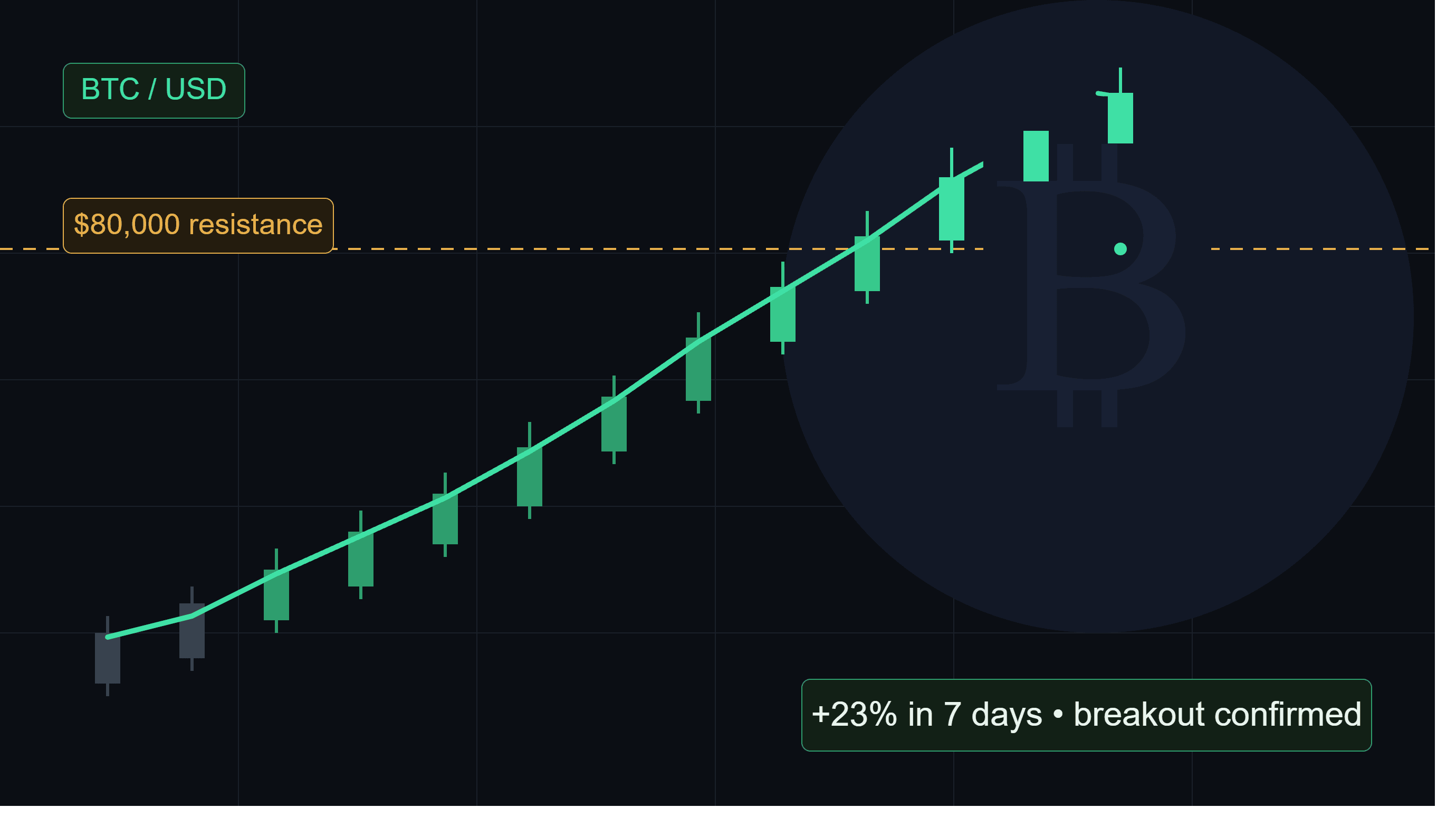
Bitcoin Just Hit $80,000: Last Week WEEX's Prediction Came True — What's Next?
Bitcoin hit $80,000 as WEEX predicted last week. See what drove the breakout, current key levels, and whether $90,000 is next.
The Twilight of Native Crypto
Nikita Bier Charges $500 Per Minute for Consulting Services
Andrew Kang's Shareholder Letter: Robotics Investment Reaches a Turning Point, Private Valuations Still Severely Lagging
Bitcoin Spot Demand: The Signal That Hadn't Reappeared Since the October 2025 Record
Vietcombank Warns of AI-Driven Fraud
$1 Billion in 48 Hours: X Prepares Crypto Trading Function on Feed