
Even with Gunfire Behind Bars, Why Do American Small Towns Oppose AI Data Centers?

 Prefer us on Google


On April 7, voters in Festus, Missouri, recalled four of eight city council members over the approval of a $6 billion AI data center project at the end of March. The project, led by Clayco's data center development arm CRG, spans 360 acres and has an undisclosed Fortune 100 end user (codenamed Project Cumulus).
The city council signed off on the project without a public hearing, leading local residents' group Wake Up JeffCo to sue the city government and CRG in St. Louis County court, with a recall petition against the mayor underway. According to Tom's Hardware, around the same time, Indianapolis councilman Ron Gibson's home was shot at multiple times late in 2025, with a "No Data Centers" note left at his doorstep.
Festus is not alone. Recently, Indianapolis councilman Ron Gibson's home was sprayed with 13 bullets in the dead of night, waking his 8-year-old son. A handwritten note at the door read, "No data center allowed." The FBI is investigating. Jordyn Abrams, a researcher at George Washington University's extremism program, points out that data centers are becoming targets for anti-tech, anti-government extremists.

Ron Gibson shooting scene
The advocacy group Data Center Watch, in its Q2 2025 report, has updated the number of organized opposition groups from 142 a year ago (in 24 states) to 188 (across 40 states). The value of halted or delayed projects has risen from $64 billion to $162 billion. On April 1, 2026, Port Washington, Wisconsin, passed the first-ever nationwide referendum explicitly targeting a data center, with 66% of voters in favor of adding a mandatory referendum threshold for projects receiving over $10 million in TIF subsidies.
All these events collectively answer the same question: Will the true bottleneck of AI capacity expansion be at the county and city ballot boxes?
Backlash in Full Swing
Plotting the events of the past 23 months on a map of the United States, two tiers of backlash are apparent. One is at the state level, with eight states having submitted or passed data center pause bills, including Maine (passed 82-62 in the House, extending to 2027), Vermont (paused until July 2030), Virginia (introduced by Democratic Delegate Irene Shin, paused until 2028), Georgia, Maryland, South Dakota, Wisconsin, and Minnesota. This tier represents legislative action, with the broadest impact but slowest progress.
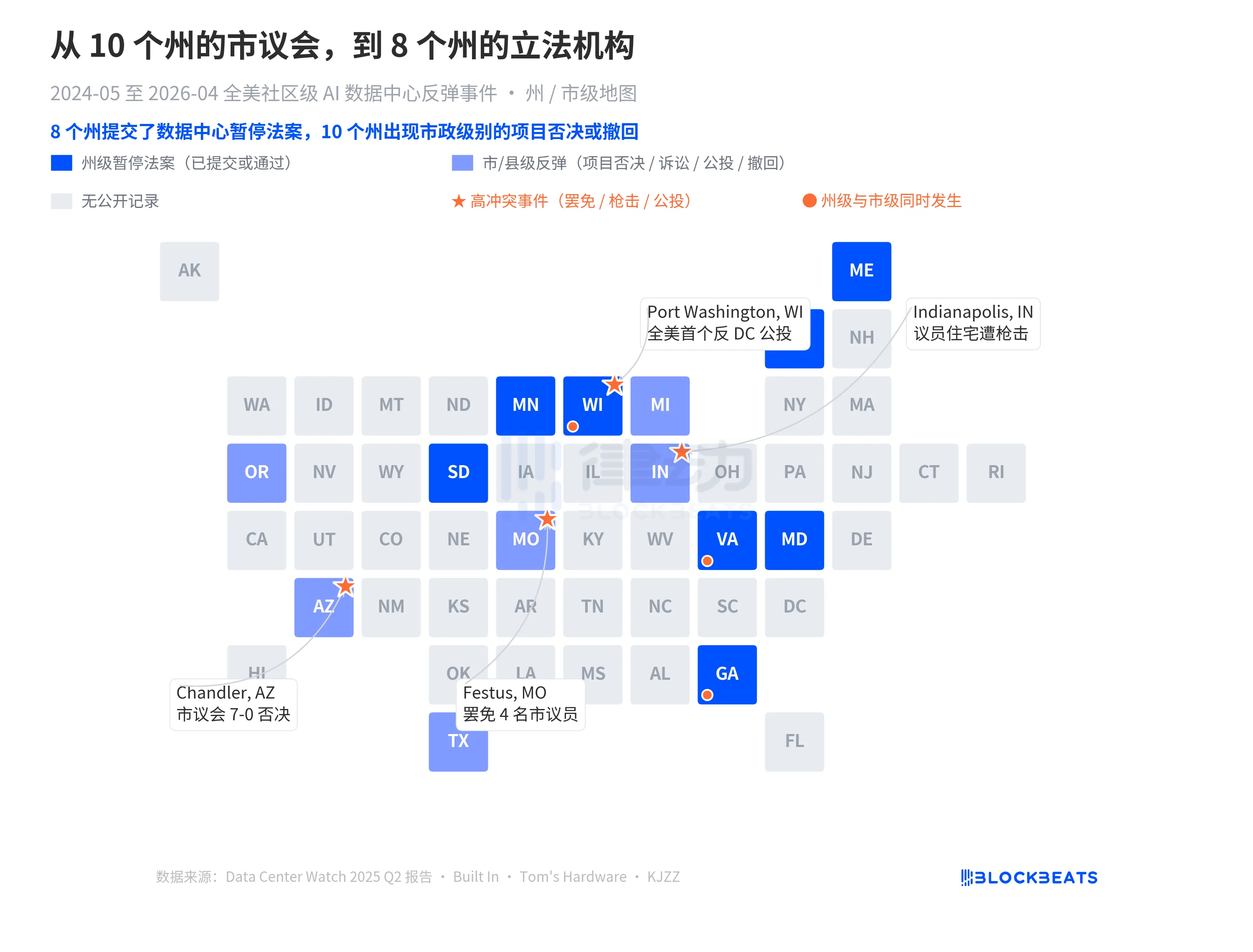
Another type is at the municipal or county level, with a more intense and vigorous backlash. The Chandler City Council in Arizona unanimously rejected Active Infrastructure's $2.5 billion project in December 2025 (lobbied by former U.S. Senator Kyrsten Sinema). The Tucson City Council in the same state is currently reviewing data center zoning restriction regulations, with public feedback open until the end of April 2026. Hays County/San Marcos in Texas rejected a $1.5 billion project in a 5-2 vote. Other locations include Cascade Locks in Oregon, Chesterton in Indiana, Catlett Station in Virginia, Peculiar in Missouri, and Lansing in Michigan. According to Data Center Watch, at least 10 states have seen direct rejections at the city government level or developers withdrawing their plans.
Over half of the high-conflict incidents are concentrated in the Midwest and South Central regions. This area has been a hotspot for data center siting due to the relative grid capacity surplus over the past decade. Now, the backlash is concentrated in the same region. From another perspective, the suppliers are moving from the "power plant surplus states" and encountering the most politically sensitive layer of local politics.
$60 Billion — Not in the Same League
The financial scale of Festus makes the $60 billion figure impossible for the city council to digest normally. According to local newspaper myleaderpaper citing municipal budget documents, Festus's FY2025 general fund plus public safety operational budget is $17.64 million, total municipal expenses in FY2024 were $37.41 million, and an estimated year-end reserve of $28.09 million for FY2025.
The $60 billion data center project is around 340 times the annual operating budget, equivalent to $450,000 per resident in a city with 13,200 residents. In relative terms, this is not a local development project up for discussion but rather a small town being plugged into a capital pipeline completely unrelated to itself.
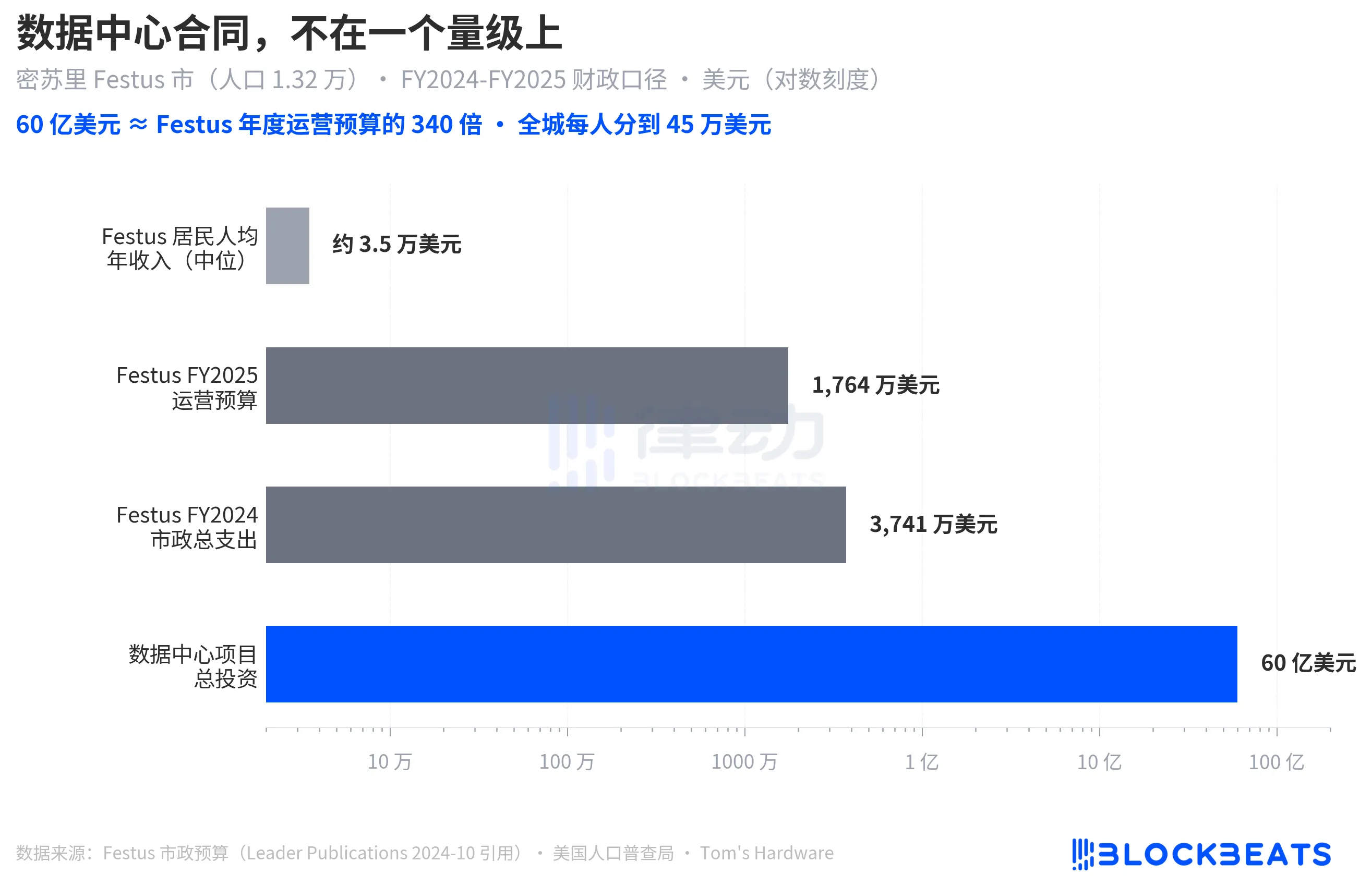
Contrasting this with Festus residents' median per capita income of approximately $35,000 in non-metro Missouri sheds light on the issue. Any decimal in the data center contract is greater than the entire community's lifetime disposable income per capita. Local officials lack the experience to balance such numbers. The criticism of the Festus City Council resolution being dubbed "not open for public hearing" is technically due to the fact that such projects typically involve commercial confidentiality clauses (with neither the developer nor end customer identities disclosed), rendering normal city council procedures unable to review confidential contracts. This is a structural flaw, not an oversight by individual council members.
Due to the difference in scale, splitting a data center contract into a size that can be handled by a local council is inherently unfeasible. That's why in the past 12 months, the rebound path has not been resolved within the legislative process but through the use of three external weapons: recalls, lawsuits, and referendums. In a rare case, Festus saw its four city council members recalled, a lawsuit filed by a residents' group in St. Louis County Circuit Court, and the initiation of a mayor recall petition, with all three paths triggered simultaneously.
A Data Center Consuming a Small Town
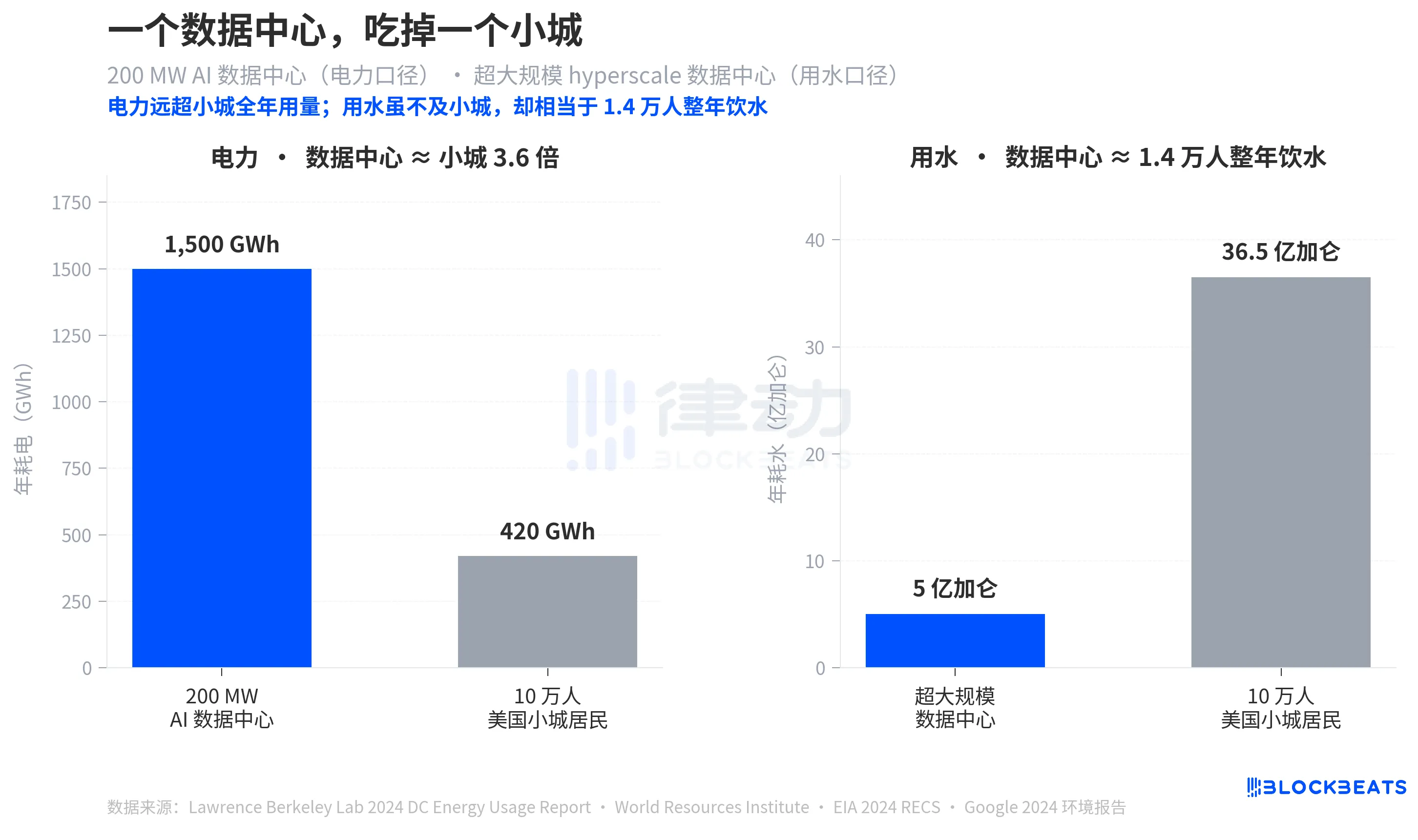
The power usage of an AI data center is best understood by comparing it to a small town in the United States. A fully loaded 200 MW AI data center, with an 86% load factor, consumes about 1,500 GWh annually. In comparison, a small U.S. town of 100,000 residents consumes approximately 420 GWh per year (based on the U.S. Energy Information Administration's EIA average annual residential electricity consumption of 10.5 MWh per household, assuming 2.5 people per household). The data center consumes electricity 3.6 times that of the town's residents. And this is only for electricity, not accounting for cooling and associated water usage.
Water usage, on the other hand, presents a more intuitive comparison. Based on the U.S. Geological Survey's typical residential water use (100 gallons per person per day), a town of 100,000 residents consumes around 36.5 billion gallons of water per year. In contrast, a hyperscale AI data center such as Google's Council Bluffs (the largest Google data center in the U.S.) consumes 500 million gallons of water per year. In absolute terms, the data center's water consumption is 13.7% of the town's usage. However, in a different perspective, it is equivalent to the water consumption of 14,000 people for a whole year. In a small town with a population of 10,000 to 50,000, this means allocating a significant portion of the city's water supply system to a single user. According to Lawrence Berkeley Lab's 2024 Data Center Energy Report, U.S. data centers consumed 17 billion gallons of water directly for cooling in 2023 and 211 billion gallons of water indirectly (for power generation). Direct water usage is expected to double or even quadruple by 2028.
The most commonly heard protest slogan is "our well will run dry." Looking at the numbers, this is not an emotional expression. In 2023, Loudoun County in Virginia (the county with the most concentrated data centers in the U.S.) had a potential water usage of 8.99 billion gallons by data centers, accounting for around 10% of the county's total water usage, according to local water supply data cited by Sierra Club and Grist. If at the county level it's already significant, the numbers at the town level would be even more extreme.
-- Price
Planned Capacity in Development, Entering Rebound Window
The true capacity of U.S. data centers that have actually been commissioned is approximately 50 GW, according to FERC and Wood Mackenzie 2025 Q4 data. The planned pipeline totals 241 GW, with 33% in active development (around 80 GW) and another 67% (around 161 GW) yet to be initiated. BloombergNEF predicts an additional 97 GW of capacity to be added in the U.S. from 2025 to 2030, with the data center electricity demand peaking at 106 GW by 2035. All these numbers point to one fact: the vast majority of the capacity is still on the drawing board and not yet implemented.
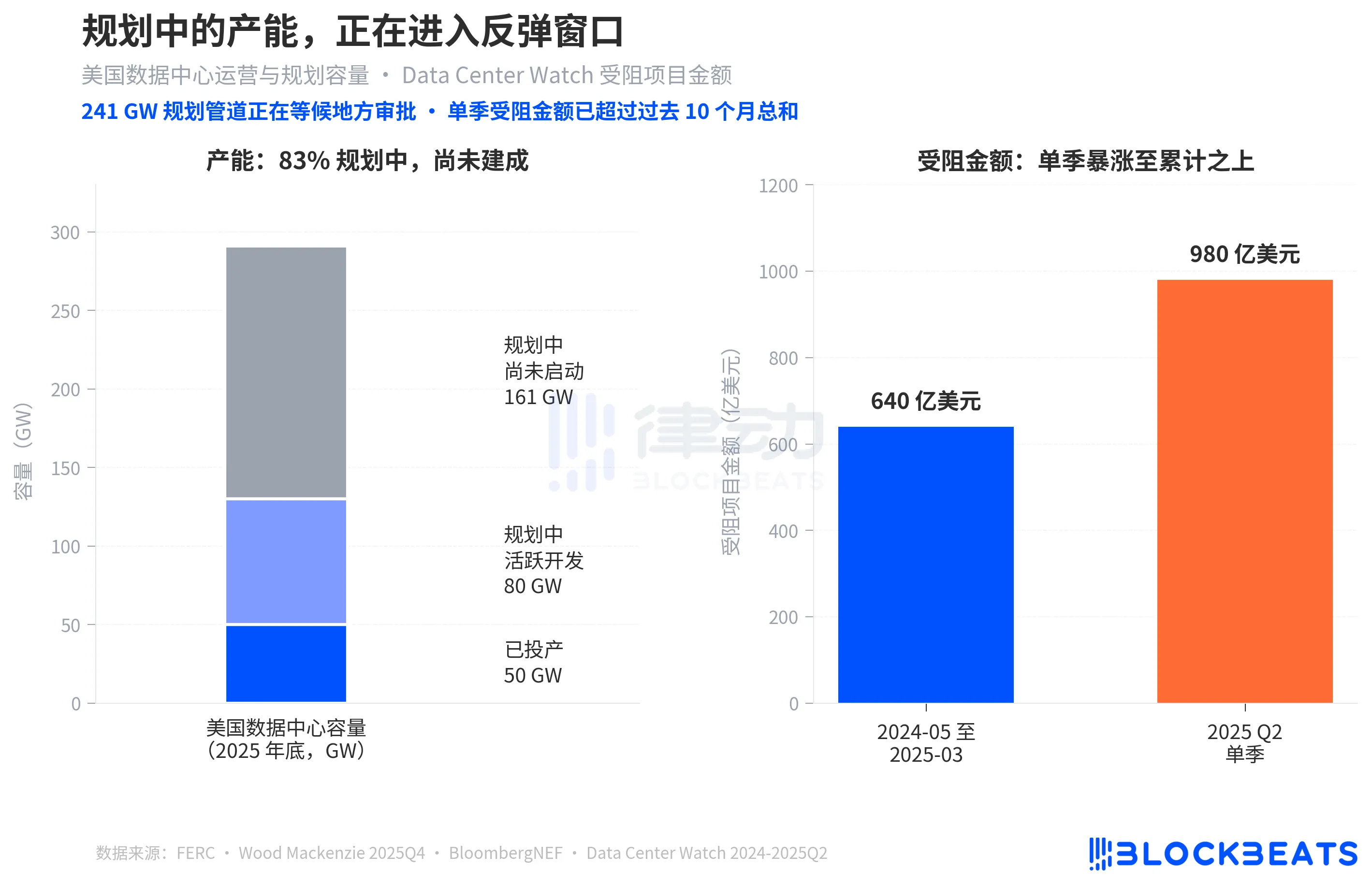
According to data revealed by Sightline Climate via TechRadar, of the 16 GW originally scheduled to come online in 2026, 30% to 50% are expected to be canceled or delayed. Meanwhile, Data Center Watch's data shows that from May 2024 to March 2025, over 10 months, $64 billion worth of data center projects were stopped or delayed due to organized opposition. In the single quarter of 2025 Q2, this figure was $98 billion corresponding to 20 projects. The amount blocked in a single quarter has exceeded the cumulative total of the previous 10 months.
This sets up a timing mismatch. Capital has already committed to doubling U.S. data center capacity over the next five years, but the new capacity has to navigate through each level of county and city approvals. The more planned capacity there is, the larger the surface area that can be held back by rebound. Cases like Festus were able to escalate from a city council vote to recall and lawsuits within a month not because it was unique but because the number of opposition organizations increased by 46 in a year (according to the Data Center Watch 2025 Q2 report) and shared templated legal tools across states, including TIF subsidy referendums, zoning litigation, and legislator recalls. Whether a long-term power agreement signed by a cutting-edge lab will materialize depends on which counties these contracts land in and which residents are watching those county councils.
The bottleneck in AI capacity expansion, stepping out of power contract negotiation for the first time, appeared on the recall vote cast by 13,200 people.
This content is provided for general informational purposes only and doesn't constitute financial, investment, legal, or tax advice. Any events, rewards, online promotions, or related information mentioned herein should not be considered a recommendation, solicitation, or invitation to purchase, sell, trade, or otherwise deal in any crypto assets. Crypto assets are highly volatile and may result in loss. The availability of WEEX services, products, and related events may vary by region. You are responsible for ensuring that your participation is in accordance with applicable local laws and regulations.
You may also like

SpaceX officially submitted its prospectus, unveiling the largest IPO in history

The decentralized derivatives trading platform Variational has completed a $50 million Series A financing round, led by Dragonfly Capital

How long will it take for the GPU futures market when computing power is commoditized?

Why is a16z Crypto raising another $2.2 billion to heavily invest in Web3?

AI intelligent entity platform Nova Intelligence completes $31.5 million Series A financing, led by Chemistry

Jito plans to launch the trading application JTX, entering the consumer market

Rain receives support from Mastercard to promote on-chain settlement integration, with a valuation close to 2 billion dollars

Haun Ventures completes $1 billion new fundraise, expanding investment scope to the AI agent field

Why can this institution still grow by 150% when the scale of leading crypto VCs has shrunk significantly?

Eve of Ceasefire, US Military Fires on Iranian Vessel | Rewire News Morning Brief
《Fortune》 Investigation Exposes: Crypto Whales Trader, Fiancée Dies Mysteriously in Africa

Senators pressure the U.S. Department of Justice and the Treasury Department regarding Binance's related fund flows to Iran

Rejecting the "Security Theater": Wallet Security is Entering the Era of Verifiability
Is It a Dead Cat Bounce or the Bull Market Revival? How Do Traders View It?

RootData Transparency Alert: Projects like Sentism.AI, Ultima, and Etherex are missing core information

The encrypted hedge fund Split Capital announced its closure, and the founder is transitioning to join Plasma

Robinhood's private equity fund has rebounded by 30% after poor initial performance, but it may face challenges from super IPOs like SpaceX

The first prediction market protocol combining fortune cookie elements on BSC, Fortune's official website is now live

AI data company Mercor confirmed it has suffered a significant data breach involving clients such as OpenAI and Anthropic
Americans are saying that the cost of living has become so high that it's unaffordable, and the reason is the $700 billion AI investment.

Paradigm is developing a prediction market trading terminal aimed at professional traders and market makers

The Exit Signal is Pricier Than the Entry Signal | Rewire News Morning Brief
On-chain private credit startup Valinor has completed a $25 million seed round financing, led by Castle Island Ventures
Federal Reserve Chair Contender Rick Rieder Oversees BlackRock's $2.4 Trillion Assets, Seen as America's Bond Market Guru

Financial Technology Infrastructure Alpaca Completes $150 Million Financing Round, Led by Drive Capital

Fireblocks Acquires Crypto Accounting Platform TRES for $130 Million

Cryptocurrency Venture Capital Firm Shima Capital Reportedly Quietly Shutting Down Operations

Coinbase to Acquire Solana Ecosystem Exchange Platform Vector.fun

Mastercard is reportedly considering spending up to $2 billion to acquire Zerohash, betting on stablecoin infrastructure.

Source: Blockworks is gradually shutting down its newsroom and pivoting to expand its data business
SpaceX officially submitted its prospectus, unveiling the largest IPO in history
The decentralized derivatives trading platform Variational has completed a $50 million Series A financing round, led by Dragonfly Capital
How long will it take for the GPU futures market when computing power is commoditized?
Why is a16z Crypto raising another $2.2 billion to heavily invest in Web3?
AI intelligent entity platform Nova Intelligence completes $31.5 million Series A financing, led by Chemistry
Jito plans to launch the trading application JTX, entering the consumer market

Contents
Latest articles


Latest coin listings on WEEX


