
TSMC Stock After Record Q2 Earnings: Why TSM Slipped

 Prefer us on Google

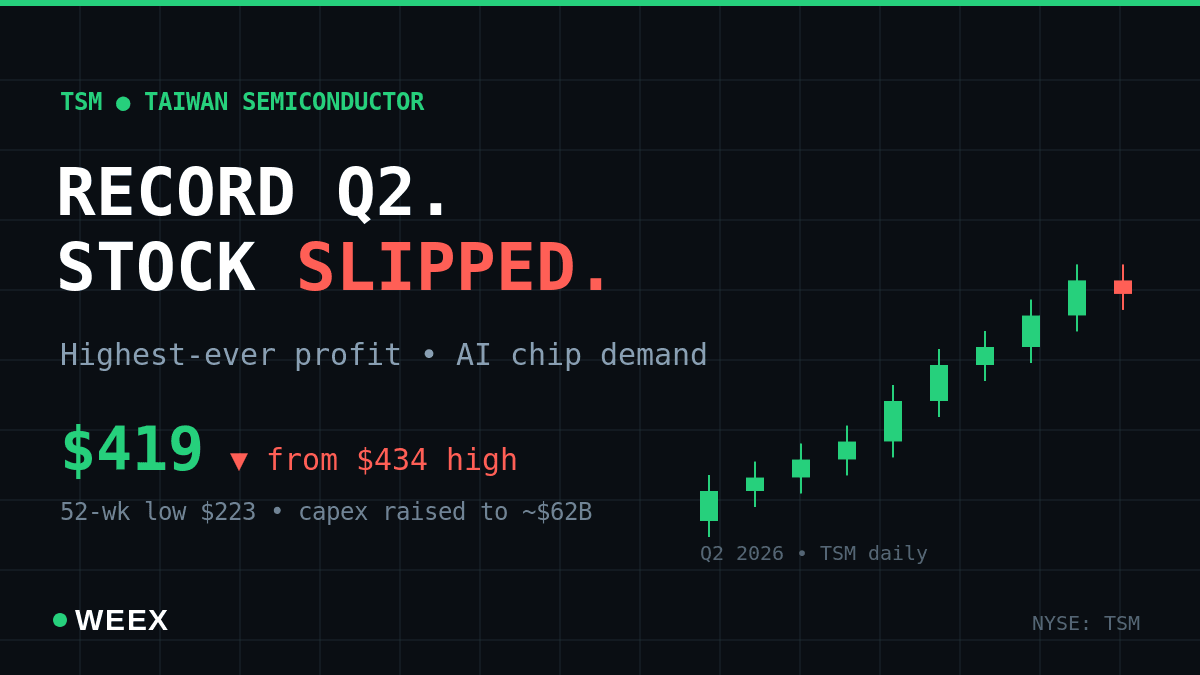
TSMC stock did something unusual on July 16, 2026: it delivered a record quarter and still sold off. Taiwan Semiconductor Manufacturing Company posted its highest-ever profit, driven by relentless AI chip demand, yet TSM traded near $419 in mid-July after slipping from an early-July high around $434. The gap between the results and the reaction is the whole story for anyone weighing TSMC stock right now — because the numbers were spectacular, but the guidance came with a bill attached.
This piece breaks down what TSMC actually reported, why the stock fell on good news, where analysts see the price going, how to buy TSMC stock or get exposure without a brokerage, and the risks that can still undo the bull case.
What Happened to TSMC Stock After Q2 2026 Earnings
TSMC stock had run hard into the print, more than doubling off its 52-week low of roughly $223 to trade near $434 in early July. That setup mattered: a stock priced near a record high needs a flawless report, not just a strong one.
The report was strong. It was also the trigger for a semiconductor-wide pullback, and TSM eased back toward $419 by mid-July. The reason was not the profit line — it was the spending line. TSMC raised its 2026 capital expenditure budget to roughly $60–64 billion (about $62 billion at the midpoint) and flagged margin pressure from its overseas fab build-out, including a plan to invest an additional $100 billion in Arizona, lifting its cumulative U.S. commitment toward $265 billion. Markets read heavy capex and margin caution as a near-term cost, even as they confirm long-term demand.
Why Did TSMC Stock Fall Despite Record Profit?
TSMC stock fell because expectations, not fundamentals, drove the trade. When a stock is already priced for perfection near its 52-week high, "record earnings plus higher spending" is not automatically a buy signal — the market had largely priced the beat and then focused on what the guidance costs.
Three things pulled the stock lower. First, the capex hike raises depreciation and squeezes future gross margin, even though it signals confidence in demand. Second, overseas expansion in Arizona is structurally less profitable than TSMC's Taiwan fabs, so faster U.S. build-out dilutes margins during the ramp. Third, a stock this extended is vulnerable to simple profit-taking; a normal 3–5% cooldown looks dramatic after a vertical run.
TSMC Q2 2026 Earnings: The Numbers That Matter
The quarter itself was a genuine blowout, powered by high-performance computing, which now makes up about two-thirds of revenue. The table below is the fast read.
| Metric (Q2 2026) | Reading | Why it matters |
|---|---|---|
| Revenue | ~$40.2B (NT$1,270.38B) | Record quarter, up ~34–36% YoY |
| Net income | NT$706.56B | +77.4% YoY, fifth straight record quarter |
| EPS (per ADR) | ~US$4.31 | Up 77.4% YoY, well above prior-year $2.47 |
| Gross margin | 67.7% | Elite profitability, but guidance points lower ahead |
| HPC share of revenue | ~66% | AI/data-center demand is the core engine |
| 2026 revenue guidance | >40% growth in USD | Raised outlook — the bull case's backbone |
| 2026 capex | ~$60–64B | The reason the stock cooled despite the beat |
The signal buried in these numbers: TSMC is not demand-constrained, it is capacity- and capital-constrained. That is a high-class problem, but it is also why the near-term margin picture is the swing factor for TSMC stock.
-- Price
Is TSMC Stock a Good Buy After Earnings?
TSMC stock is a high-quality business at a demanding price, so the honest framing is "the company is not the question — the entry price is." On roughly 30% (now guided above 40%) revenue growth, dominant leading-edge share, and an anchor customer list of Apple, Nvidia, and AMD, the fundamental case is intact and arguably strengthened by the raised outlook.
The catch is valuation. Before the print, TSM carried a trailing P/E near 38 against a ten-year average around 22 — a premium that leaves little cushion for a soft quarter or a margin scare. The better reading after earnings is that the pullback removed some froth without breaking the thesis: buyers now pay a slightly less stretched price for a company that just told you demand is accelerating. That is more attractive than chasing the pre-earnings high, but it is not a bargain.
TSMC Stock Forecast: Analyst Price Targets for 2026
Wall Street stayed bullish through earnings, with a consensus near "Strong Buy" and price targets that were widely raised. The average 12-month target sits around $500–$520, and several firms pushed higher after the report.
| Scenario | 2026 price zone | What it would take |
|---|---|---|
| Bull | $520 – $600+ | AI orders stay hot, capex fears fade, margins hold up |
| Base | $460 – $520 | 40% revenue growth confirmed, sentiment steady |
| Bear | Below $400 | Margin compression, chip-cycle turn, or geopolitical shock |
Notable post-earnings moves included targets raised toward $590 and $600 at some firms, while more cautious desks anchored near $470–$500. From about $419, the average target implies double-digit upside, but the spread tells you conviction is high and the range of outcomes is not narrow. For the round-number debate specifically, the detailed case in this breakdown of whether TSM can break above $500 in 2026 is worth reading alongside the fresh guidance.
How to Buy TSMC Stock — or Get Exposure Without a Brokerage
The standard way to buy TSMC stock is the TSM ADR on the NYSE, which trades like any U.S. equity through a mainstream brokerage and is the cleanest option for long-term investors. If you want the primary listing, some brokers offer direct access to Taiwan's exchange, where TSMC trades as ticker 2330 in New Taiwan dollars; one U.S. ADR represents five Taiwan shares.
Not everyone has clean access to U.S. or Taiwanese equities, which is where crypto-native routes come in. Tokenized US stocks are blockchain-based tokens that mirror a real stock's price and trade 24/7, though they carry their own custody, liquidity, and rights limits. Traders who want only price exposure — not ownership — can use a stock-linked futures market such as TSM/USDT perpetual futures on WEEX, which tracks TSM's price without giving you shares, dividends, or voting rights. For the full menu of routes and a deeper price breakdown, see WEEX's guide to TSMC stock price, 2026 forecast, and how to get exposure.
The distinction is what traders most often blur: an ADR or Taiwan share makes you a part-owner of TSMC, while a tokenized product or futures contract is a price wrapper. Leverage on futures magnifies both gains and losses, so it is a trading tool, not a substitute for long-term ownership.
Key Risks for TSMC Stock
The single largest overhang is geopolitics. TSMC's most advanced manufacturing is concentrated in Taiwan, so cross-strait tension can move the stock on headlines regardless of fundamentals — a risk no earnings beat can fully offset. The Arizona build-out reduces this concentration over time, but it does so slowly and at a margin cost.
| Risk | What can go wrong |
|---|---|
| Geopolitical | Taiwan tension hits the stock on headlines |
| Margin/capex | $62B capex and overseas fabs pressure gross margin |
| Valuation | Premium multiple leaves little room for a soft quarter |
| Chip cycle | Semiconductor demand is historically boom-and-bust |
| Customer concentration | A few AI and phone customers drive orders |
| AI sentiment | A broad AI-stock reset would drag TSM lower |
The practical trap: most people who lose money on a name like this buy near a range high with leverage, then get shaken out on a routine 10–15% drawdown. After a record quarter and a stretched chart, position size and entry discipline matter more than being right on the long-term direction.
Conclusion
TSMC stock just showed why quality and price are different questions. The Q2 2026 report — record profit, +77.4% earnings growth, and raised full-year guidance above 40% — confirms TSMC as the core beneficiary of the AI build-out. Yet the stock slipped toward $419 because $62 billion of capex and overseas margin dilution give the market a near-term reason to hesitate on a chart that had already doubled. For long-term investors, the TSM ADR remains the cleanest way to own the AI supply chain; for traders who want price exposure without holding shares, TSM/USDT stock-linked futures on WEEX offer a flexible alternative — sized with the leverage and volatility risk firmly in mind. New users can register on WEEX and review the product rules, margin requirements, and risk controls before trading.
FAQ
1. Why did TSMC stock fall after record Q2 2026 earnings?
The profit beat was already priced into a stock near its 52-week high, so investors focused on the negatives in the guidance: a capex hike to roughly $62 billion and margin pressure from overseas fabs. Heavy spending and dilution outweighed the record profit in the short-term reaction.
2. What did TSMC report for Q2 2026?
Revenue was about $40.2 billion (NT$1,270.38 billion), up roughly 34–36% year over year, with net income of NT$706.56 billion, up 77.4%, and a gross margin of 67.7%. High-performance computing made up about 66% of revenue.
3. Is TSMC stock a good investment after earnings?
TSMC is a high-quality business with accelerating, AI-driven revenue growth, but it trades at a premium valuation. The post-earnings pullback removed some froth without breaking the thesis, so entry price and risk tolerance are the deciding factors rather than business quality.
4. What is the TSMC stock forecast for 2026?
Analyst consensus stayed near "Strong Buy," with an average 12-month target around $500–$520 and some firms raising toward $590–$600 after earnings. Cautious estimates sit near $470, so the range of outcomes is wide.
5. How do I buy TSMC stock?
Most investors buy the TSM ADR on the NYSE through a standard brokerage. You can also buy the primary Taiwan listing, ticker 2330, in New Taiwan dollars if your broker supports it. One ADR equals five Taiwan shares.
6. Can I get TSMC exposure without a stock brokerage?
Yes. Tokenized US stocks mirror a stock's price on-chain and trade 24/7, and stock-linked futures such as TSM/USDT on WEEX track TSM's price with leverage. Neither gives you real shares, dividends, or voting rights.
7. Why is TSMC raising capital spending so much?
Demand for advanced AI chips is outpacing capacity, so TSMC is expanding aggressively, including an added $100 billion for Arizona toward a cumulative $265 billion U.S. plan. The spending signals confidence in demand but pressures near-term margins.
8. What are the biggest risks to TSMC stock?
Geopolitical tension around Taiwan, margin pressure from record capex, a premium valuation, the cyclical nature of chip demand, customer concentration, and a possible AI-sentiment reset are the main risks.
Risk Warning
TSMC stock and any stock-linked derivative are volatile and can result in partial or total loss of capital. The TSM ADR carries equity-market, currency, and concentrated geopolitical risk tied to Taiwan, and its premium valuation raises the odds of sharp drawdowns after disappointing quarters. Stock-linked futures such as TSM/USDT add leverage risk, funding costs, and liquidation risk, and they do not grant ownership, dividends, or voting rights. Tokenized stock products carry additional custody, liquidity, counterparty, and regulatory risks, and may not be available in all regions. Never trade with more than you can afford to lose, and confirm live prices and product rules before acting.
This content is provided for general informational purposes only and doesn't constitute financial, investment, legal, or tax advice. Any events, rewards, online promotions, or related information mentioned herein should not be considered a recommendation, solicitation, or invitation to purchase, sell, trade, or otherwise deal in any crypto assets. Crypto assets are highly volatile and may result in loss. The availability of WEEX services, products, and related events may vary by region. You are responsible for ensuring that your participation is in accordance with applicable local laws and regulations.
You may also like

Nike Stock and the China Sales Collapse: What a 30% Revenue Drop and Cutting Thousands of Distributors Actually Signals

BTC to MYR: Why the Ringgit Price of Bitcoin Has Two Legs
Logista Stock (LOG): The August 2026 Interim Dividend, the Four Dates That Decide Who Is Paid and What the Company Is
Manta Network (MANTA) Token Unlock: Supply Details, Allocation Breakdown and Price Risks

ETHFI Price Today: Why Ether.fi Is in Focus Ahead of Its Token Unlock

Santander Reveals a $4.3 Million Bitcoin Investment: What Europe's Biggest Bank Buying IBIT Actually Signals

SNDK Stock and the $93.9 Billion NBM Agreements: What SanDisk's New Business Model Actually Changes

Is Reddit Stock a Buy After Falling From Its Highs? What the S&P 500 Inclusion Actually Changes

Reddit Stock Jumps 11% After S&P 500 Inclusion: What Joining the Index on August 18 Actually Changes
Santander Stock and the Webster Acquisition: What the Federal Reserve Approval Actually Changes
What Is IREN? How the AI Data Center Company Behind Microsoft's $9.7 Billion Contract Actually Works

IREN Stock and the Microsoft Delivery: What Completing Horizon 1 and Getting Nvidia's Exemplar Status Actually Mean
MU Stock After the 28% Drop: What Micron's HBM Backlog Says
Is OpenAI Publicly Traded? The Foundation That Controls It, and the Ticker That Isn't Theirs
Is HIMS Stock a Buy After the Earnings Selloff? What the Full-Year Guidance Raise Actually Implies

CRWV Stock After Q2: Demand Is Fine, the Interest Bill Isn't
Is Bitcoin Preparing for a Bullish Breakout? Key Technical Indicators and On-Chain Data
MSFT Stock and the 30 Million Copilot Seats Milestone: What Growing From 20 Million Actually Changes
RKLB Stock After Q2: Record Revenue, Wider Loss, Narrower Window
Strategic Petroleum Reserve 2026: What's Left and What It Can Do
Apple Stock and CXMT: What Testing Chinese Memory Chips for iPhone Actually Means for AAPL
Jensen Huang Stock Advice: What He Said and What It Returned
Metaplanet (3350): What the Japanese Retail Boards Argue About — and How to Check Each Claim
KGHM Stock Forum: Copper, Silver, and the Argument the Thread Keeps Getting Backwards
JSW Stock Forum: What the Threads Are Actually Arguing About — and What They Cannot Tell You
What Is Phantom Wallet? How to Install the Official Version Safely and Use It
How Zero Knowledge Proofs Are Used in Blockchain Today

What Is Zero Knowledge Proof? A Beginner's Guide
PGP vs End-to-End Encryption: What's the Difference?
Roblox Stock Price Prediction 2026-2027: Can RBLX Recover After Pulling Full-Year Guidance?
Nike Stock and the China Sales Collapse: What a 30% Revenue Drop and Cutting Thousands of Distributors Actually Signals
BTC to MYR: Why the Ringgit Price of Bitcoin Has Two Legs
Logista Stock (LOG): The August 2026 Interim Dividend, the Four Dates That Decide Who Is Paid and What the Company Is
Manta Network (MANTA) Token Unlock: Supply Details, Allocation Breakdown and Price Risks
ETHFI Price Today: Why Ether.fi Is in Focus Ahead of Its Token Unlock
Santander Reveals a $4.3 Million Bitcoin Investment: What Europe's Biggest Bank Buying IBIT Actually Signals
Contents
Popular coins
Latest articles


