Bank Account Freeze Risk for Crypto Traders in Pakistan 2026

 Prefer us on Google


For most Pakistani crypto traders, the expensive failure is not a price crash or a hack. It is a mobile wallet that stops accepting transfers, or a bank account placed under review, in the middle of a P2P trade — with crypto still in escrow and a merchant waiting. Bank account freeze risk in Pakistan is largely a documentation and pattern problem, and it is far more avoidable than most users assume. This piece explains why transfers get flagged, what actually triggers a review, the habits that keep your rails clean, and what to do when a payment is held.
Why crypto-related transfers get flagged at all
Banks and mobile wallets run automated monitoring against money-laundering rules. Those systems do not evaluate whether you are a legitimate trader; they evaluate whether the pattern of a set of transactions resembles patterns associated with illicit flows.
Ordinary P2P behaviour resembles those patterns more than it should. A retail crypto buyer sends money to strangers, frequently, at irregular intervals, in amounts that do not match a salary pattern, sometimes at three in the morning, and receives money from other strangers on the way back out. There is nothing wrong with any of that. It simply looks, to a rules engine, like a high-turnover unexplained flow.
Regulatory context has shifted in Pakistan's favour here. The State Bank lifted its restriction on banks serving crypto firms in April 2026, and the Virtual Assets Act 2026 built a licensing regime under PVARA. But policy permitting banks to serve licensed businesses is a different thing from your own current account being read as a legitimate crypto flow. Bank-level monitoring did not switch off when the licensing regime opened.
What actually triggers a review on a PKR account
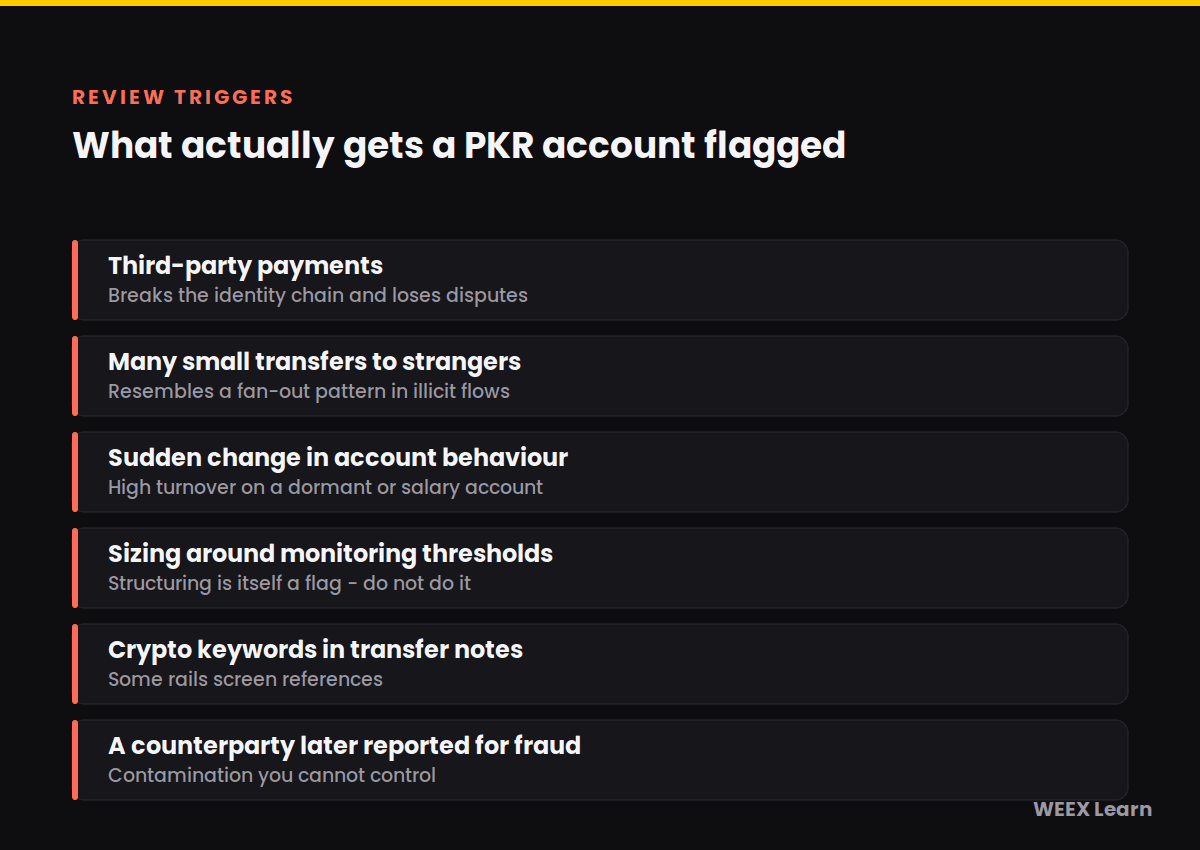
Six patterns account for most cases, and each has a lower-risk alternative.
- Payment from or to a third party's account. It breaks the identity chain and is also the single biggest cause of lost P2P disputes. Use only accounts in your own verified name.
- Many small transfers to many unrelated individuals. This resembles a fan-out pattern used in illicit flows. Fewer, larger trades with established merchants read very differently.
- Crypto keywords in the transfer note. Some rails screen references. Keep references neutral and factual — never falsify them.
- A sudden change in account behaviour. New high-turnover activity on a dormant or salary account stands out. Let activity build gradually rather than starting at size.
- Deliberately sizing payments to stay under monitoring thresholds. Structuring is itself a flag and is treated seriously. Do not do it — transact at your genuine size.
- Receiving funds from an account later reported for fraud. This is contamination through a counterparty you never met. Trading with high-completion merchants inside escrow is the only real defence.
That last one is the one nobody controls and everybody underestimates. If you sell USDT and the buyer pays you with money that is subsequently reported as fraudulent, your receiving account can be caught in the investigation even though you did nothing wrong. That risk is why merchant quality on the sell side matters more than the extra fraction of a rupee a marginal buyer offers.
Keeping your rails clean: Six rules
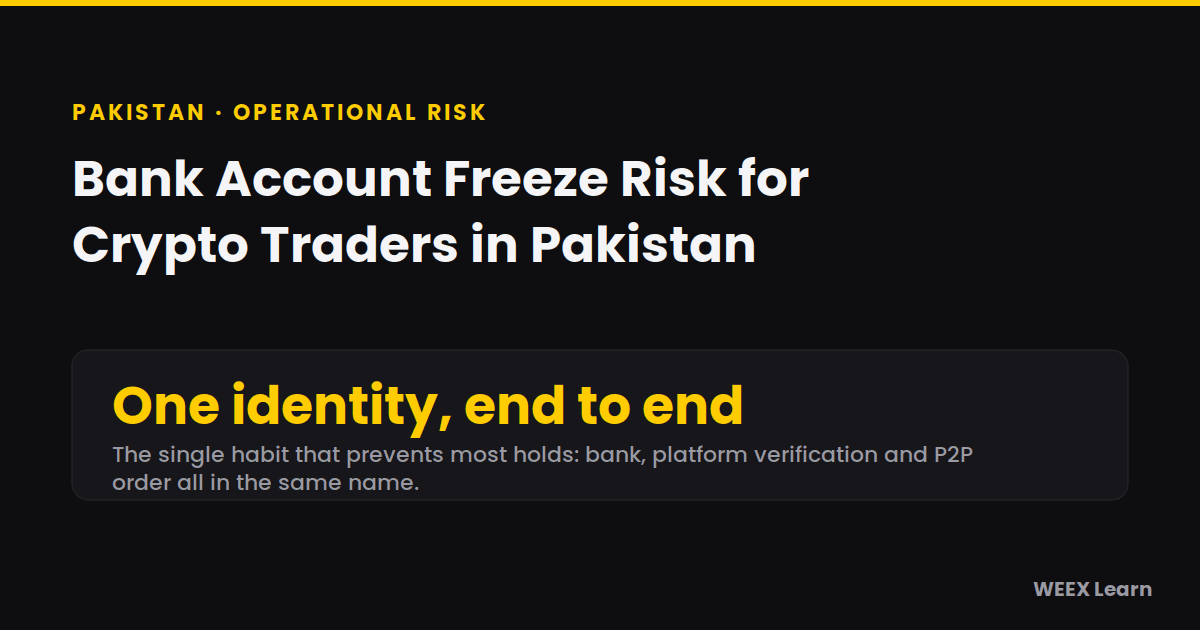
- One identity, end to end. The name on your bank or wallet account, your platform verification, and the P2P order must match. No exceptions for a spouse's or brother's account, however convenient.
- Keep the trade inside the order. If a counterparty asks to move to WhatsApp or Telegram, stop. Off-platform arrangements strip away escrow and leave you with no evidential record. The standard P2P fraud playbook is worth reading once before it is relevant.
- Verify money in your own account before releasing crypto. A screenshot or an SMS is not a payment. This rule prevents both fraud and the freeze that follows a reversed transaction.
- Keep statements matched to orders. A folder with the trade export and the corresponding wallet statement turns a two-week investigation into a one-email answer.
- Do not engineer amounts around thresholds. Splitting payments specifically to stay below a monitoring level is structuring, and it converts an ordinary flow into a deliberate one.
- Use rails suited to the hour. Instant rails like Raast settle quickly and are harder to dispute after the fact; slower bank transfers outside banking hours leave orders hanging longer, which is where disputes start. The mechanics of paying through the instant rail are covered in this Raast P2P guide.
-- Price
What to do if a transfer is held or an account is frozen
First, do not open a second account and continue trading through it. That is the reflex, and it is the thing most likely to turn a routine review into a serious problem.
Then, in order:
Stop the flow. No further crypto-related transactions on that account until the review resolves.
Assemble the evidence. Trade history export, P2P order IDs with timestamps, the platform's record of the corresponding trade, and the statement lines. What compliance teams want is a coherent story linking each rupee movement to a crypto movement.
Respond through the official channel. The bank or wallet provider's formal complaint process, in writing. Keep copies.
Handle the open trade separately. If crypto is stuck in escrow while your payment is held, use the platform's appeal process rather than cancelling. A cancelled but paid order is much harder to unwind than an appealed one. On the sell side, the sequencing discipline in the PKR sell-side guide exists precisely for this scenario — verify before releasing, always.
Expect the process to take longer than feels reasonable. Traders who resolve these quickly are almost always the ones who already had records, not the ones who argued best.
Does PVARA licensing make this go away?
Partly, and not yet. As licensed venues and bank relationships mature, the plausible end state is a regulated fiat rail where a crypto purchase is a recognised, documented transaction rather than an unexplained transfer to a stranger. That is the point of building a licensed tier.
Until that infrastructure is actually live and widely available, the practical position for 2026 is unchanged: you are still settling through general-purpose payment rails that were not designed for this, monitored by systems that cannot see the trade on the other side. Your documentation is what fills that gap.
Frequently asked questions
1. Can my bank account be frozen for buying crypto in Pakistan?
Trading crypto is legal, but banks and wallets run anti-money-laundering monitoring, and P2P activity can trigger a review. Freezes usually follow the transaction pattern or a counterparty problem, not the legality of crypto itself.
2. Why did Easypaisa or JazzCash block my transfer?
Common causes are transfers to or from accounts not in your name, an abrupt change in account activity, or a counterparty later associated with a fraud report. Contact the provider through its formal channel with your order records.
3. Is it safer to use a bank account or a mobile wallet for P2P?
Neither is inherently safer. What matters is that the account is in your own verified name, the rail suits the hour you are trading, and you can produce statements matching your orders.
4. Can I use a family member's account for a P2P payment?
No. Third-party payments break the identity chain, are the most common cause of lost disputes, and are among the strongest triggers for a compliance review.
5. What if a buyer pays me with money that turns out to be stolen?
Your account can be drawn into the investigation. Reduce the risk by trading with high-completion merchants inside escrow, verifying payer names against the order, and keeping full records of every trade.
Risk Warning
Crypto assets are volatile and you can lose part or all of the money you commit. The risks in this article are operational rather than market-driven, and they are real: a bank or mobile-wallet account used for crypto flows can be restricted or frozen while a transfer is reviewed, funds can be inaccessible for an extended period, and a counterparty's fraudulent payment can affect your account even when you have done nothing wrong. P2P trading carries dispute and fraud risk that escrow limits but does not remove. Never pay from or into an account that is not in your own name, never structure payments to avoid monitoring thresholds, and never release crypto before confirming funds in your own account. This article is general information, not legal, tax or financial advice.
This content is provided for general informational purposes only and doesn't constitute financial, investment, legal, or tax advice. Any events, rewards, online promotions, or related information mentioned herein should not be considered a recommendation, solicitation, or invitation to purchase, sell, trade, or otherwise deal in any crypto assets. Crypto assets are highly volatile and may result in loss. The availability of WEEX services, products, and related events may vary by region. You are responsible for ensuring that your participation is in accordance with applicable local laws and regulations.
You may also like
Micron (MU) Earnings Date: When Q4 FY2026 Reports and What to Watch
Is Crypto Legal in Pakistan? PVARA Rules Traders Must Know
PKR to USDT Rate: How to Spot a Bad P2P Spread in Pakistan
Crypto Tax in Pakistan: What FBR Rules Mean for PKR Traders
Why USDT Still Dominates Crypto Buying in Pakistan Today
Bitcoin Price Over 10 Years: Historical Recap and Long-Horizon Outlook
How to Buy USDT with JazzCash in Pakistan Safely in 2026
JazzCash Crypto Guide: How PKR-to-USDT P2P Payments Work in Pakistan
Why Is DGrid AI (DGAI) Trending After Its Exchange Debut?
SOXSB Explained: Why the 3x Chip Bear ETF Resets Without You
Crude Oil Price Holds Its Iran Premium as Hormuz Stays Shut
ADI After Strong Q3 Earnings: Overvalued or Still Undervalued?
Choosing a Crypto Exchange in Pakistan Before the Sept 5 Deadline
How to Buy Crypto in Pakistan With PKR After the Bank Rule Change
Trump XST: How to Tell a Real Trump Token From a Fake Link
MSTR Stock Surges 12% in a Single Session: What Strategy Inc's Bitcoin Treasury Model Actually Amplifies
Best Crypto Exchange in Pakistan for 2026: What You Need to Know Before Choosing
Bitcoin Hits $70K: How Trump’s CLARITY Act Could Impact Crypto Markets
XRP ETFs Have Pulled Nearly 1 Billion Tokens off the Market: Why the Price Keeps Sliding Anyway
Walmart Stock Falls 9% After Q2 Earnings: What Weak Same Store Sales and Cautious Guidance Actually Signal
XRP Price Breaks Above $1.18 Resistance as Whales Accumulate 190 Million Tokens: What the Breakout Actually Signals
XST Share Price: Why XSolut Has No Share Price and What the Token Price Actually Represents
XST Coin and Stargate: What XSolut's AI Infrastructure Narrative Has to Do With the $500 Billion OpenAI Project
SK Hynix (SKHY) Announces Record $28.6 Billion Buyback: 40 Trillion Won in Shares to Be Cancelled, Shareholder Return Target Raised Above 50%
QQQB and the Fed: What the FOMC Minutes Mean for Nasdaq-100
How to Trade Unitree Stock When You Can't Buy 688836
Broadcom (AVGO) Earnings Date: September 2, 2026 (Confirmed) — Japan Time and What to Watch
Roblox Stock Price Prediction 2026-2027: Can RBLX Recover After Falling From $142 to $38

Roblox Stock Is Down 68% in the Past Year: What Age Verification and Sands Capital's Exit Actually Signal
Pakistan Stock Exchange Performance in 2026: What Is Driving the KSE 100 to Record Highs
Micron (MU) Earnings Date: When Q4 FY2026 Reports and What to Watch
Is Crypto Legal in Pakistan? PVARA Rules Traders Must Know
PKR to USDT Rate: How to Spot a Bad P2P Spread in Pakistan
Crypto Tax in Pakistan: What FBR Rules Mean for PKR Traders
Why USDT Still Dominates Crypto Buying in Pakistan Today
Bitcoin Price Over 10 Years: Historical Recap and Long-Horizon Outlook
Contents
Popular coins
Latest articles